


Automation in Logistics: The Key to Operational Optimization
09-08-2025 402
As e-commerce booms and the demand for freight transport increases, automation in Logistics helps businesses optimize costs, improve efficiency and minimize operational errors. Thanks to advanced technologies such as robots, AI, IoT or smart warehouse management systems, the Logistics industry is transforming strongly to keep up with the development of the digital economy.
Mục lục
What is Automation in Logistics?
Automation in Logistics is the process of applying technology, equipment, and software to perform activities in the logistics chain. Automation is applied in warehousing, transportation, order processing, goods sorting, and data management—automatically or semi-automatically, to reduce human intervention, increase efficiency and accuracy.
In other words, it is the use of systems such as robots, sensors, warehouse management software (WMS), artificial intelligence (AI), Internet of Things (IoT)... to replace manual operations, helping businesses operate faster, save costs, and optimize processes.
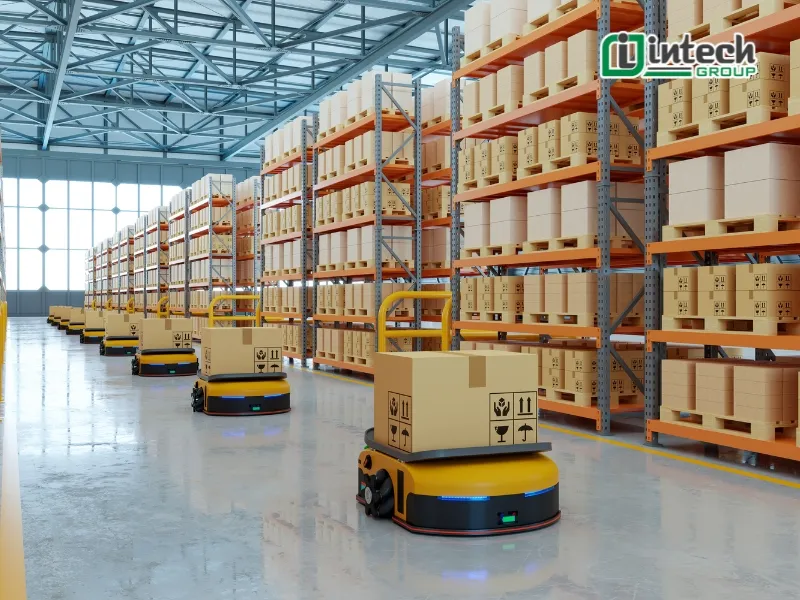
For example:
- A distribution center uses autonomous guided vehicles (AGVs) to pick goods from shelves and transport them to the packing area.
- The WMS system automatically allocates storage locations based on size, weight, and frequency of shipments.
Why is Automation Needed in Logistics?
Automation is becoming a key factor in helping the Logistics industry adapt and develop in the face of rapid market changes.
- The strong development of e-commerce
The boom in e-commerce has caused a sudden increase in the number of orders, especially during peak occasions such as festivals and promotions. Processing millions of orders every day accurately and quickly is a big challenge if relying only on manual labor. Automation helps process orders, pack, classify and transport faster, reduce errors and ensure delivery speed.
According to data presented at the Summary Conference of the Department of E-commerce and Digital Economy (Ministry of Industry and Trade), the e-commerce sector in Vietnam continues to record strong growth, ranging from 18 to 25% per year. In 2024 alone, the market size exceeded the 25 billion USD mark, an increase of about 20% compared to the previous year and accounting for about 9% of the total retail sales of consumer goods and services nationwide. These figures clearly reflect the increasingly popular trend of online shopping behavior in consumers' lives.

- Rapid development of technology
The remarkable progress of technologies such as artificial intelligence (AI), Internet of Things (IoT), autonomous vehicles (AGV), and smart management software has opened up many new opportunities to upgrade and optimize logistics processes. Businesses that do not apply automation early will fall behind in global competition.
- Increasing customer demands
Customers today expect faster, more accurate, more flexible delivery and the ability to track orders in real time. Automation enables businesses to meet these demands more efficiently, while improving customer experience and increasing satisfaction.
- Shortage of human resources
The logistics industry is facing a shortage of labor, especially in manual operating positions, due to the difficult working environment and fluctuations in the labor market. Automation helps reduce dependence on human resources, solve the problem of labor shortage and improve work efficiency.
In which stages of Logistics is automation applied?
Thanks to the advancement of robots, artificial intelligence and IoT, transportation, warehousing and supply chain operations are increasingly less dependent on manual operations.
1. Transportation stage
- Self-driving vehicles: Self-driving trucks remove drivers from the cockpit, thereby reducing accidents due to human factors and increasing control accuracy.
- Smart routing software: Machine learning algorithms exploit real-time traffic data to suggest the fastest and most economical route for each shipment.
- Integrated TMS: The transportation management system records the location of goods, automatically reports the delivery and receipt status, while limiting manual input errors and providing instant data to managers.
2. Warehousing
- Automated warehouse: WMS combines barcodes, RFID with pick-and-pull robots to turn all import, export, unloading, and stacking operations into a closed process.
- Support robots: Smart lifting equipment handles heavy lifting, moves pallets to the correct location, helping workers focus on higher-value tasks.
- Track the entire life cycle of goods: From when goods enter the warehouse until they leave, information is always recorded synchronously, ensuring traceability and reducing loss.
3. Supply chain management
- IoT sensors: Machines and goods are equipped with sensors, data is continuously sent to the server, allowing immediate monitoring and adjustment when there are abnormalities.
- AI analysis: The system automatically warns, forecasts demand, optimizes supply plans and makes decisions based on accurate data.
- Transparent blockchain: When information from all links is automatically collected and linked into a blockchain, transparency and trust between manufacturers, distributors and customers are strengthened.
Typical automation technologies in Logistics
Automation has become a core driving force to help the supply chain operate more efficiently, safely and transparently. Below are six prominent technologies that are widely applied in the modern Logistics industry.
1. Smart warehouse management system (WMS)
WMS is the “brain” that coordinates all activities in the warehouse. Thanks to the ability to connect with barcodes, RFID and IoT sensors, the system:
- Real-time tracking of location, quantity and status of each item code.
- Automatically suggests optimal arrangement diagrams to save space and shorten travel distance.
- Synchronize import - export data with ERP, TMS, helping information flow seamlessly from ordering to delivery.
As a result, businesses reduce “dead” inventory, limit errors and increase order processing speed.
2. Robots and automated systems in the warehouse (AGV, AMR)
- AGV (Automated Guided Vehicle): Runs along painted lines, magnets or wires, suitable for environments with fixed routes.
- AMR (Autonomous Mobile Robot): Uses LIDAR sensors and digital maps to self-orient and avoid obstacles flexibly.
These two technologies handle picking, pallet pulling, and shelf replenishment, helping to:
- Reduce heavy manual labor and accidents.
- Shorten order preparation time, especially during peak e-commerce hours.
- Enable scale expansion by simply adding robots, without increasing warehouse space.

3. Automatic sorting line
The conveyor system combines a barcode scanning camera and a lever arm to coordinate parcels to the correct delivery “door”. Algorithms that analyze shape, weight, and destination help:
- Process tens of thousands of packages/hour with high accuracy.
- Optimize the order of loading onto vehicles, reducing empty space.
- Shorten the “end of shift” lead‑time (cut‑off time), so customers can still place orders later in the day.
4. Drones in delivery and inventory
- Delivery: Drones overcome difficult terrain (islands, mountainous areas, congested inner-city areas), deliver small parcels in minutes, reducing emissions and “last mile” costs.
- Warehouse inventory: Drones with cameras and RFID scanners fly between high shelves, counting inventory without stopping operations. This is especially useful in cold storage, where humans find it difficult to work for long periods of time.
5. AI and Machine Learning in demand forecasting and operational optimization
- Accurate forecasting: Analyze historical data, market trends, special events to predict demand, helping to reduce excess inventory and avoid shortages.
- Route & fleet optimization: ML algorithms compare thousands of scenarios, recommending routes that save time and fuel.
- Predictive maintenance: AI recognizes “fatigue signs” of robots, conveyors, forklifts, and schedules maintenance before breakdowns occur.
6. IoT in cargo and vehicle monitoring
Sensors mounted on containers, trucks, pallets continuously measure temperature, humidity, vibration, GPS location and transmit data to the center:
- Early warning when cold goods exceed the allowable temperature threshold, preventing damage.
- Help shippers and customers track routes, increase transparency.
- Analyze device data to optimize routes, reduce fuel consumption and CO₂ emissions.
Challenges of automation in Logistics
Despite bringing many benefits, the implementation of automation in Logistics still faces many difficulties:
- High initial investment costs: Deploying robotic systems, management software, IoT sensors and related technologies requires large capital, especially for small and medium-sized enterprises.
- Difficulties in system integration: New automation solutions may not be easily compatible with existing systems, causing disruption or slowing down operations.
- Lack of skilled human resources: The effective operation, maintenance and exploitation of automated technologies requires a qualified technical team, which many businesses currently lack.
- Cyber and data security risks: When the operating system depends on a digital platform, the risk of cyber attacks or information leaks is a concern.
- Changes in the organization and corporate culture: The transition to an automated operating model requires adaptation from personnel, process changes and acceptance of innovation - which is not always easy to do.
Automation is not just an option, but a strategic solution for sustainable development of Logistics in the new era. Investing in automated technology will help businesses adapt quickly to market fluctuations, better meet customer expectations and create a long-term competitive advantage on the journey of comprehensive digital transformation.
