


Automation in mechanical engineering industry
09-08-2025 540
Automation in the mechanical engineering industry is becoming a key factor in improving productivity and product quality in many of these fields. The application of modern automation technologies not only helps businesses optimize production processes but also creates a superior competitive advantage in the market.
Mục lục
What is automation in the mechanical engineering industry?
Automation in the mechanical engineering industry is the process of applying technologies, equipment and automatic control systems (such as CNC machines, industrial robots, CAD/CAM software, sensors, IoT, etc.) to the stages of production, processing, assembly and testing in the mechanical engineering field.
The goal of automation is to increase accuracy, improve productivity, reduce production costs and limit dependence on manual labor, thereby optimizing the production process and enhancing the competitiveness of enterprises.
In other words, automation helps the mechanical engineering industry transform from a traditional production model to a smart production model, in line with the trend of the 4.0 Industrial Revolution.
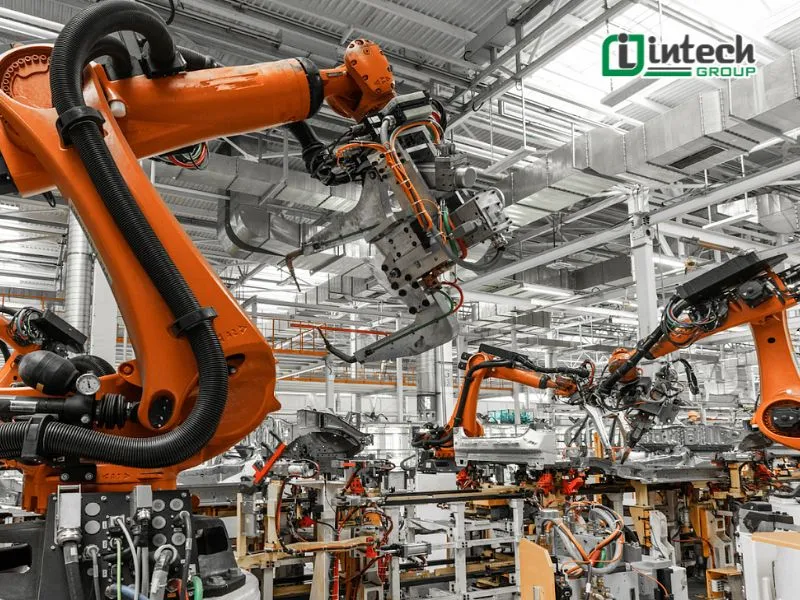
The role of automation in mechanical engineering
1. Increase productivity and production efficiency
One of the most obvious benefits of automation is the ability to increase production productivity significantly compared to traditional manual methods. Automatic devices such as CNC machines, industrial robots or smart production lines can operate continuously for long periods of time without stopping, significantly shortening the production cycle.
In addition, automation also ensures stability and uniformity in product quality, which is difficult for manual labor to maintain. From there, production efficiency is significantly improved, promptly meeting large orders with strict requirements.
2. Reduce labor costs, reduce production errors
Automation helps reduce dependence on manual labor, thereby saving long-term labor costs for businesses. Instead of needing many workers to operate each stage, only a few technicians are needed to control and monitor the machine system.
Furthermore, thanks to precise programming and standardized operations, automated machines help minimize production errors caused by human factors. This not only saves materials and error correction time but also enhances the business's reputation with customers for product quality.
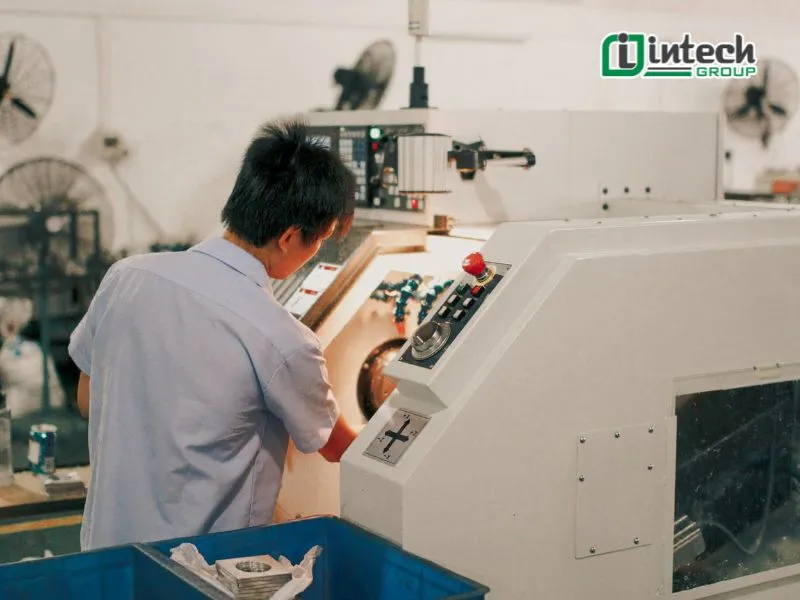
3. Optimize the production process
Automation helps businesses easily manage, monitor and improve the production process through control software, sensor systems and real-time data. Each stage is programmed, closely monitored and can be flexibly adjusted as required.
As a result, the production process becomes transparent, accurate and easy to control, helping to save materials, reduce waiting time between stages, and increase the ability to adapt to market changes. This is an important factor that helps mechanical enterprises move closer to the "smart manufacturing" model.
Practical applications of automation in the mechanical engineering industry
1. CNC (Computer Numerical Control) control system
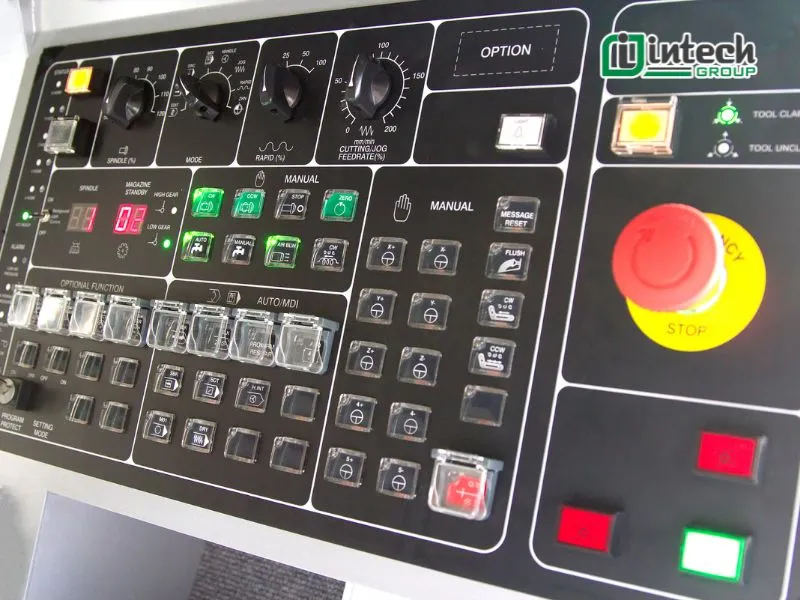
CNC is a technology that allows processing machines (such as turning, milling, drilling, etc.) to be programmed and precisely controlled by computers. CNC helps to process parts with high precision, stable repetition and superior productivity compared to manual methods.
CNC machines can work continuously for many hours without stopping, minimizing human errors and optimizing the use of raw materials. This is especially important in mass production and processing parts with high technical requirements.
Typical applications:
- CNC milling machine: Capable of creating complex surfaces with high precision, often used in the production of molds, aircraft and automobile components.
- CNC lathe: Specialized in processing parts cylindrical section, creating products with high precision and uniformity.
- CNC plasma/laser cutting machine: Allows cutting metal with high precision and fast speed, minimizing material waste.
- CNC waterjet processing machine: Uses high-pressure water jet to cut materials, especially suitable for heat-sensitive materials.
2. Industrial robots
Industrial robots are widely used in stages such as welding, assembly, loading, coating and product inspection. Robots are capable of working in harsh, toxic environments that are difficult for humans to participate in.
With flexible programming capabilities, robots help increase flexibility in production, while ensuring consistent product quality. In addition, the use of robots also contributes to ensuring labor safety and minimizing accidents in factories.
Classification of industrial robots
- Articulated robots: Have a structure similar to a human arm with 4-6 degrees of freedom, flexible in the workspace.
- Robot SCARA: Simpler design, often used for assembly operations.
- Delta Robot: High speed, often used for "pick and place" operations.
- AGV/AMR Mobile Robot: Able to move freely in the factory, transporting materials and products.
- Cobot (Collaborative Robot): Robot can work safely with humans in the same space.
3. Automatic production line
An automatic production line is a model that integrates many automatic devices and technologies into a closed process, from input materials to output products. The application of an automatic production line not only helps increase production speed but also limits errors, saves manpower and makes quality management easier.
Basic structure:
- Conveyor system: Transports materials and products between work stations.
- Automatic processing station: Includes CNC machines, robots and specialized equipment.
- Automatic quality control system: Uses cameras, sensors and measuring devices.
- Central control system: Monitors and coordinates the operation of the entire line.
- Automatic storage and transportation system: Manages warehouses and transports raw materials.
Flexible Manufacturing System (FMS)
FMS is a high-end automated manufacturing system that can quickly adapt to product changes. FMS usually includes:
- Flexible CNC machining centers
- Automatic transport and storage systems
- Automatic tool and tool change systems
- Intelligent central control software
FMS allows the production of many different types of products on the same line with short changeover times, meeting the diverse and flexible production needs in the era of industry 4.0.
4. Simulation and design software (CAD/CAM)
CAD (Computer-Aided Design) and CAM (Computer-Aided Manufacturing) software are indispensable tools in the field of modern mechanical engineering.
- CAD (Computer-Aided Design) is a technology that allows engineers to design products in the form of 2D or 3D models on computers.
- CAM (Computer-Aided Manufacturing) is a technology that uses computer software to control machine tools and automatic equipment in the manufacturing process.
CAD/CAM/CAE integrated system
The current trend is to integrate CAD/CAM systems with CAE (Computer-Aided Engineering) to form a synchronous system:
- Product design (CAD)
- Engineering analysis (CAE): Finite element analysis, flow simulation, etc.
- Product planning (CAM)
- All in a single software environment
Thanks to the combination of CAD/CAM, the design-to-manufacturing process becomes more seamless and efficient. Products are developed quickly, reducing testing time, reducing manufacturing errors, while increasing creativity and customization.
Automation in the mechanical engineering industry is no longer a trend, but an inevitable solution for the mechanical engineering industry to adapt to modern production requirements and international integration. The application of control systems, industrial robots, smart production lines or advanced design software is helping businesses improve their capacity and operational efficiency. In the future, automation will continue to be the key to paving the way for the mechanical industry to develop sustainably and move towards comprehensive smart manufacturing.
Automation in the mechanical engineering industry is no longer a trend, but an inevitable solution for the mechanical engineering industry to adapt to modern production requirements and international integration. The application of control systems, industrial robots, smart production lines or advanced design software is helping businesses improve their capacity and operational efficiency. In the future, automation will continue to be the key to paving the way for the mechanical industry to develop sustainably and move towards comprehensive smart manufacturing.
