


Bottled water filling line
13-08-2025 363
Modern bottled water filling lines are an important factor in improving production efficiency and ensuring product quality. With the continuous development of technology, businesses are increasingly focusing on investing in advanced filling systems to meet the increasing demands of the market.
Mục lục
So what is the structure of the bottling line, what benefits does it bring? Let's find out through the following article.
What is a bottled water bottling line?
A bottled water bottling line is a system of machinery designed to carry out the production process, from water treatment, bottling, capping, to labeling and product transportation.
This is an automated or semi-automatic solution to replace manual methods, helping to increase productivity, ensure product quality, and meet food hygiene and safety standards.
This line is often widely used in the bottled water production industry, including purified water, mineral water, and soft drinks. Depending on the needs and production scale, the line can be designed with different capacities and technologies to suit each business.
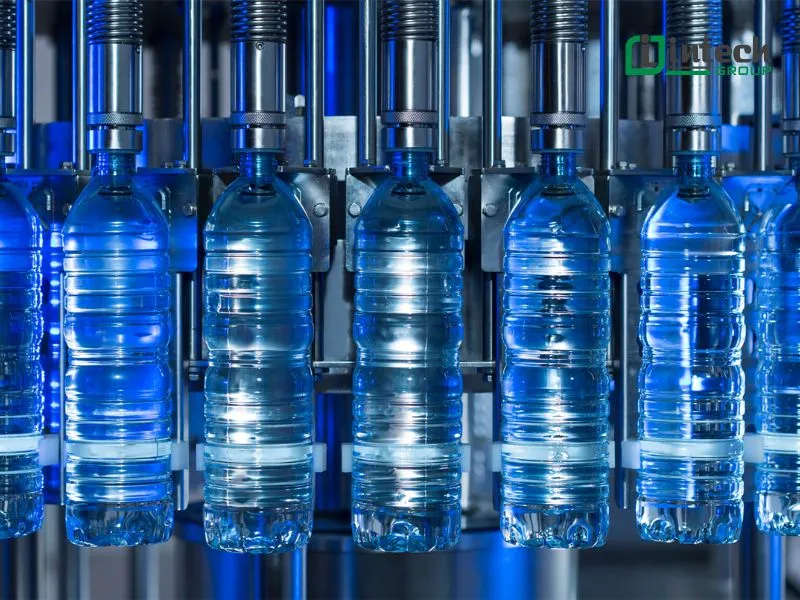
Structure of bottled water filling line
Main structure of bottled water filling line:
- Water treatment system
The water treatment system is the first and most important step in the bottled water filling process. The main function is to filter out impurities, bacteria and harmful chemicals, ensuring the water source meets food safety standards. This system usually includes:
- Mechanical filter to remove large dirt.
- Activated carbon filter to remove odor and color.
- RO (reverse) filter system to remove small impurities such as metal ions.
- UV or ozone sterilization equipment.
- Filling system
The filling system plays a central role in the line. The task of this part is to evenly pour the amount of water into the bottle, ensuring capacity standards. Depending on the production model, the filling system can be semi-automatic or fully automatic.
Water pipes can be designed for still water (flat water), still water and sparkling water (most common volumes are 330ml, 500ml, 2000ml) and for large water bottles of 3-10L or 10-20L liters can also be used in water coolers (better alternative to polycarbonate bottles – BPA-free PET bottles).
- Vacuum filling technology helps to limit bacterial contamination.
- Integrated capacity counting and automatic shut-off when the bottle is full.
- Capping/bottle machine
Capping machine is an important step to ensure that the product does not leak water or become contaminated during transportation. Modern capping machines often feature:
- Automatically position and close the cap.
- Integrated quality assurance inspection system.
- Accommodates a variety of bottle and cap styles.
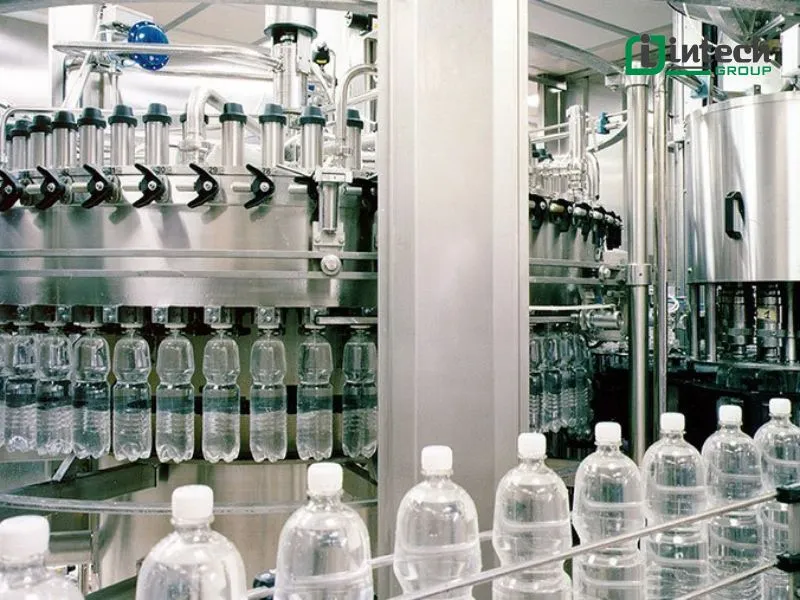
- Date/label printer
Date and label printers provide product information such as production date, expiry date and brand. Key features include:
- Fast printing, clear, quick drying.
- Supports multiple languages and label styles.
- Automatic connection to production lines.
- Conveyor belt
The conveyor belt ensures continuity in the process of transporting bottles through production steps. Modern conveyor belts feature:
- Stable operation, easy speed adjustment.
- Anti-slip, suitable for many bottle sizes.
- Integrated sensors for increased automation.
Classification of popular bottled water filling lines
Bottled water filling lines are an indispensable part of the beverage and purified water production industry. Depending on the scale and production needs, the filling line is classified according to many different criteria. Here are two common classification criteria:
1 - Classification by capacity
+ Mini filling line
Mini filling lines are a suitable solution for small production facilities or start-up businesses. The capacity of this type of line usually ranges from a few hundred to a few thousand bottles per hour.
The main advantages are low investment costs, compact design, easy installation and operation. This is an ideal choice for units that want to control product quality well without large investments.
+ Large capacity lines
For businesses with large production needs, usually over 10,000 bottles per hour. This line integrates modern technology, ensuring high efficiency, meeting the needs of large-scale industrial production.
Although the initial investment cost is high, large capacity lines bring long-term economic efficiency, especially when businesses need to expand the market.
2 - Classification by technology
+ Fully automated technology
Fully automated filling lines are designed to operate without much human intervention. The entire process from water treatment, filling, capping to label printing is performed automatically.
The outstanding advantages of this technology are fast production speed, high precision and ensuring food hygiene and safety standards. Suitable for large enterprises, where high output and stable quality are required.
+ Semi-automatic technology
Semi-automatic technology combines automatic and manual processes. Some stages, such as capping or labeling, may require human participation.
Semi-automatic lines are often cheaper than fully automatic lines, suitable for small and medium-sized enterprises. This is a flexible solution that can be easily adjusted to meet changing production needs at each stage.
Choosing the right type of bottled water filling line depends on the production scale, investment budget and technological requirements of the enterprise. Mini or semi-automatic filling lines are suitable for small facilities, while large capacity and fully automated lines are the optimal solution for large enterprises, aiming for sustainable development and competitiveness in the market.
Advantages of using bottled water filling lines
Using bottled water filling lines offers many advantages over manual methods, especially in the context of large-scale production.
- Increase productivity and reduce labor costs
Automating the filling, capping and labeling processes significantly increases production productivity. The automatic filling line helps businesses save on labor costs by minimizing dependence on human resources.
In addition, thanks to the continuous operation of the line, businesses can meet the demand for large-scale production in a short time while still ensuring product quality.
- Ensuring food hygiene and safety standards
The bottled water filling line is designed to ensure a closed and hygienic production environment. Parts such as the filling system, capping system and conveyor belt are made of rust-proof, easy-to-clean and food-safe materials.
In addition, the automation process helps minimize the risk of contamination due to manual contact. This meets food safety standards such as HACCP or ISO 22000, helping products always achieve high quality.
- Saving production time and reducing loss
Compared to manual production methods, the automatic filling line helps shorten product completion time. The process is carried out continuously, automatically transferring bottles through the processing, filling, capping and labeling stages in a rhythmic manner.
In addition, the precise filling system helps reduce water loss during production, ensuring that each bottle reaches the correct standard capacity, thereby saving raw materials and minimizing waste.
- Easy to manage and upgrade the system
Modern filling line systems often integrate IoT technology, allowing for efficient management of production data. Smart control panels support remote monitoring and adjustment of the production process, helping to improve monitoring and optimize productivity.
In addition, this system is also easy to upgrade when businesses want to expand production scale or add new features. This flexibility helps businesses adapt better to market needs, while ensuring long-term competitiveness.
Conclusion
Investing in a bottled water filling line not only helps businesses increase productivity but also ensures that products meet high quality standards, contributing to enhancing brand reputation in the market.
If you are looking for the optimal solution for your production process, choose a modern filling line that suits your needs. This is definitely the right step for sustainable development in the future.
