


Details of 9 steps in the process of producing standard soy milk
15-08-2025 1.998
Soy milk has long been a familiar nutritious drink, bringing many health benefits and suitable for all ages. However, to have a delicious, quality glass of soy milk, the production process must go through many strictly controlled stages. So how does the soy milk production process take place? Join Intechvietnam to learn detailed information about this process so you can better understand how soy milk is made from tiny beans.
Mục lục
What ingredients is soy milk made from?
Soy milk is made mainly from soybeans, a food source rich in vegetable protein. Soybeans, after being carefully selected, must be ripe, clean, undamaged or contain impurities.
The soy milk production process begins with soaking soybeans in water to soften and easily extract nutrients such as protein, lipids and glucid. Then, the soybeans are finely ground with water to create a milk solution, which can be filtered to remove the residue, resulting in a smooth, nutritious milk product.
In addition to the main ingredient of soybeans, there are other auxiliary ingredients such as: Water, sugar, NaHCO3 additives, Potassium sorbate additives, etc.
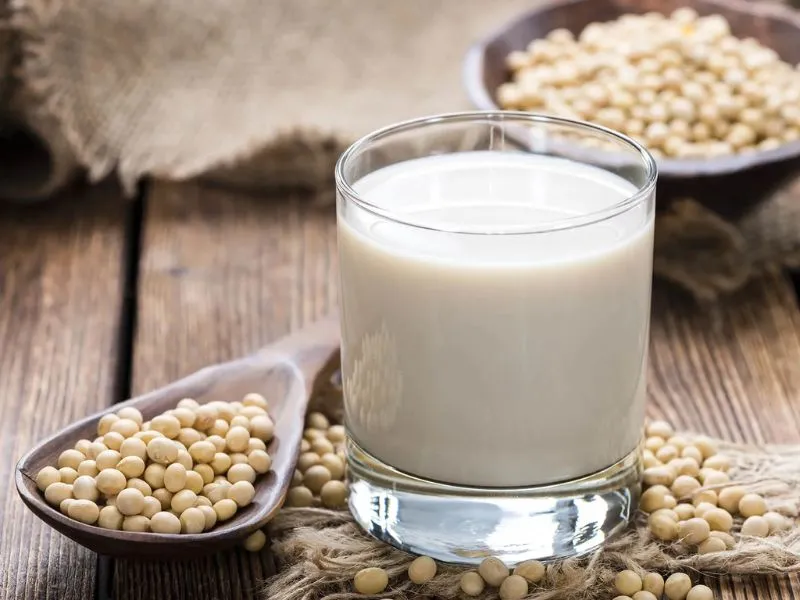
Industrial soy milk production process
Step 1. Select soybean ingredients
Soybeans play an important role in determining the quality of soy milk products, including the rate of protein recovery and sensory value. Therefore, it is necessary to choose soybeans that meet the following criteria:
- The beans must be fully ripe, remove immature beans.
- Prioritize intact, dry, clean beans, free of insects or bad odors.
- The moisture content of the seeds is between 10-14%.
- The seed coat is light brown, avoid green-skinned beans because chlorophyll causes bitterness and discolors the product during processing.
- The ratio of cracked beans does not exceed 5%, damaged and green beans does not exceed 2%, impurities do not exceed 3%.
Step 2. Soak soybeans
The purpose of soaking beans is to let the beans absorb water, soften and increase processing efficiency. Soaking beans helps:
- Hydrate nutrients such as protein, glucid, lipid for easy dispersion in milk.
- Separate the shell more easily, reduce the binding force between the shell and the seed kernel.
- Limit oligosaccharides (raffinose, stachyose) that cause indigestion, and partially destroy heat-resistant microorganisms.
How to do:
- Wash the soybeans several times before soaking with a water:bean ratio of 2:1.
- Soak the beans for 6-8 hours at a temperature of 20-25°C. During the process, change the water regularly to avoid lactic fermentation causing sourness.
- Make sure the soaking time is appropriate: if it is too short, the beans will not be soft enough; if it is too long, nutrients will be easily lost and the beans will rot easily.
Step 3. Wash and dehull the soybeans
This process aims to remove impurities and microorganisms on the shell, and at the same time remove substances that cause bitterness or negatively affect the color and taste of the product.
How to do:
- Wash the soybeans after soaking and dehull them. The shell usually floats to the surface of the water and is scooped out.
- Dehulling helps increase protein recovery efficiency when grinding, improving digestibility and product quality.
- After peeling, the beans are brighter, creating the premise for a product with beautiful color and high quality.
Step 4. Grinding soybeans
The goal of the grinding process is to break the structure of soybeans to release nutrients such as protein, glucid and lipid, dissolving in water to form a homogeneous solution. At the same time, this process also helps to deactivate the lipoxygenase enzyme and reduce the characteristic odor of soybeans.
How to do it:
After cleaning and washing the beans, the beans are put into the grinder to grind finely. The ratio of water added is 1:5 (beans: water) to optimize the extraction of nutrients into the milk.
- If the amount of water is too little, the dissolution process will not be effective, and at the same time, it will cause strong friction in the grinder, increasing the temperature and leading to protein denaturation, reducing the efficiency of nutrient recovery. On the contrary, if there is too much water, it will reduce the smoothness of the solution, leading to protein loss.
- One issue to note is that soybeans contain saparin, a water-soluble glucoside that foams during the grinding process. This can cause difficulties in the subsequent filtration step.
Step 5. Filtration
The goal of the filtration process is to remove the bean residue and obtain a whey containing protein and fat, thereby improving the heat transfer capacity in the following stages and enhancing the sensory quality of the product.
How to do it:
- After grinding, the suspension is filtered to obtain pure whey. The bean residue is washed several times to recover all remaining nutrients.
- Filtration is an important step because it directly affects the recovery efficiency of nutritional components, especially protein and lipid.
- After filtration, the whey has a characteristic color, is uniform, and has no residue or lumps.
Step 6. Heating
The heating process helps kill harmful microorganisms, destroy some enzymes, and decompose toxic substances in soybeans such as trypsin inhibitors and hemagglutinin. In addition, heating also helps remove fishy odors, improve the flavor of soy milk, and enhance nutritional value, helping the product to be preserved longer.
How to do it:
- Soy milk is cooked in an open pot, with a capacity 1/3 larger than the volume of milk to be cooked to avoid boiling over.
- You can use a pot with a stirring blade larger than 200 liters or stir by hand for pots smaller than 200 liters. The heat source can be a gas stove, coal, or use a double-shell pot with steam for large capacity pots.
- During the cooking process, it is necessary to monitor and adjust the temperature carefully to avoid milk overflowing. You can also skim off the foam that rises and stir evenly (stirring speed from 30-40 rpm) to avoid burning and clumping.
- Cooking time lasts from 10-30 minutes when the milk is at 100-130°C. Boiling the milk as quickly as possible helps to limit the formation of a new solvate shell, avoiding reducing the efficiency of protein recovery.
Step 7. Homogenization
The goal of the homogenization process is to break large particles into smaller particles and disperse them evenly in the solution, helping the product become homogeneous. This process helps prevent separation in soy milk during storage.
How to do it:
- Under high pressure from 220 - 250 kg/cm², the suspended milk stream is accelerated and when passing through the narrow gap of the homogenizer, it collides with the piston.
- At this time, the kinetic energy of the milk stream will be converted into an emulsion, helping the fat and protein particles to be dispersed more evenly in the milk solution, increasing the homogeneity of the product.
Step 8. Bottling
The purpose of bottling is to preserve soy milk and prevent the penetration of microorganisms and impurities from the outside, while improving the aesthetics of the product, facilitating the sterilization and transportation process.
How to do it:
- Bottles and caps are sterilized before filling the milk.
- The milk liquid is poured into the bottle at a temperature of 80-85°C, helping to remove the remaining gas in the bottle and limit the penetration of microorganisms. At the same time, the high temperature helps reduce the viscosity of the milk during the filling process.
- After pouring, the bottle is tightly capped.
Step 9. Sterilization
The sterilization process aims to destroy or inhibit the growth of microorganisms and their spores in soy milk. This helps to preserve the product for a long time and keeps the milk from spoiling or deteriorating. Sterilization also helps to remove compounds that cause unpleasant odors and ensures stable product quality throughout the storage period.
How to do it:
- Sterilization is carried out in an autoclave without shaking, at a temperature of 120°C for 30 minutes.
- If the temperature is too high or the sterilization time is too long, the product may change in color, taste and viscosity due to caramelization, leading to loss of nutrients. On the contrary, if the temperature is not enough, microorganisms may not be completely destroyed, causing product changes such as protein coagulation or fermentation, creating sour taste and unpleasant smell.
- The sterilized product can be stored for 6 months and must meet quality standards, including white or ivory color, no separation, no scum and no defects on the bottle cap.
Machinery used in the soy milk production process
In the soy milk production process, the main machinery plays an important role in increasing production efficiency and improving product quality. Some common machinery and their roles include:
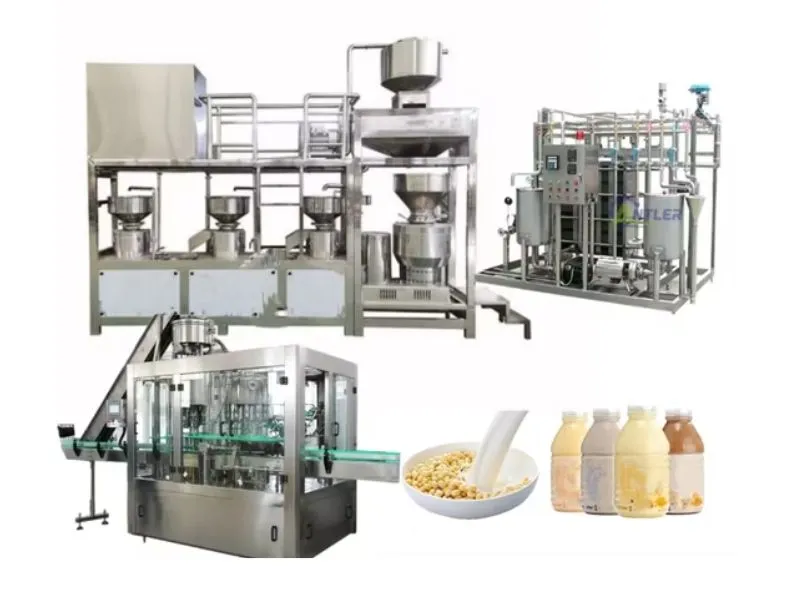
Grinding machine (Grinder): The machine is responsible for grinding the soybeans after soaking into a smooth mixture. The machine helps extract the nutrients in the beans into the water, forming milk liquid.
- Filter (Dreg Separator): Used to separate the soybean residue from the milk liquid after grinding, retaining the smooth milk suspension. The filter helps remove residue and bean residue, ensuring that the soy milk is uniform, free of lumps, and of good quality.
- Homogenizer: Helps to evenly disperse the fat and protein components in the milk liquid, creating a uniform emulsion. The homogenization process helps prevent separation in soy milk during storage, ensuring the product has high uniformity.
- Autoclave: Role: The sterilizer is used to kill or inhibit the growth of microorganisms in soy milk. The machine helps preserve the product for a long time without damage, while eliminating compounds that cause unpleasant odors, keeping soy milk safe and stable for a long time.
- Packaging machine: Helps to fill soy milk into bottles or packages, and close the lid tightly to prevent the intrusion of microorganisms and impurities. The bottling machine also helps to maintain the aesthetics of the product and facilitates the storage and transportation process.
- Conveyor: Helps to transport soybeans from the input area to other areas in the production process, such as the soaking machine, grinding machine or dehulling machine. This saves time and effort, ensuring continuity in the production process.
Nowadays, with the support of modern machinery and technology, the soy milk production process is not only optimized in terms of time and productivity but also ensures superior quality. From grinding, filtering, homogenizing, conveyor systems to sterilization equipment, each type of machinery plays an important role in maintaining the natural flavor and nutritional value of the product.
Thanks to the application of advanced technology, soy milk not only meets food safety standards but also becomes the top choice of consumers who love a healthy lifestyle.
Thanks to the application of advanced technology, soy milk not only meets food safety standards but also becomes the top choice of consumers who love a healthy lifestyle.
