


Details of industrial animal feed production process
15-08-2025 455
Animal feed production plays an important role in modern agriculture, contributing to improving the productivity and quality of livestock products. Along with the continuous development of technology, the animal feed production process is increasingly optimized, ensuring the provision of adequate and safe nutrition for livestock.
Mục lục
Explore the details of the process and factors affecting this important field through the article below.
An overview of the market and methods of animal feed production
Industrial animal feed is a product manufactured using modern technology, aiming to meet the comprehensive nutritional needs of livestock. This type of feed helps livestock develop well, grow quickly and improve the efficiency of producing products such as milk, meat, eggs, feathers and many other products.
Currently, the country has 269 factories producing complete mixed animal feed with a total design capacity of 43.2 million tons. Of these, 90 factories belong to FDI enterprises, accounting for 33.5% in quantity and 51.3% in design capacity, while the remaining 179 factories belong to domestic enterprises, accounting for 66.5% in quantity and 48.7% in design capacity.

In terms of output, the animal feed industry reached 18.8 million tons in 2018 and increased to 20.8 million tons in 2022. This period recorded a change in output structure, when the proportion of FDI enterprises increased from 59.8% to 62.5%, while domestic enterprises decreased from 40.2% to 37.5%.
In Vietnam, animal feed production often applies two main methods:
- Powdered feed
- Pelleted feed
Regardless of the method used, the production process must be strictly implemented to ensure product quality. In addition, the production line also needs to be invested in modern and fully equipped.
Industrial feed production process
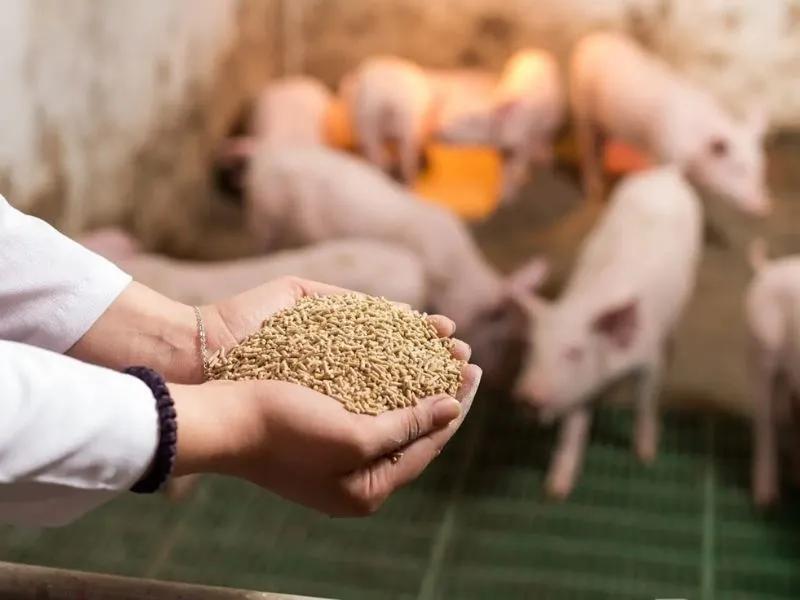
Step 1. Formulate nutritional rations
Planting nutritional rations plays a key role in ensuring that feed fully meets the needs of livestock, optimizes production efficiency and controls raw material costs. Depending on each stage of development, livestock need different rations, including key factors such as: minimum level, relative level, actual level, full level and supplementary level.
In the process of formulating rations, the following steps must be taken:
- Assess the nutritional needs of each species and each stage of development.
- Select and combine appropriate ingredients.
- Calculate costs and check the availability of raw materials.
- Apply the method of formulating rations to achieve the most optimal efficiency.
Step 2. Select quality raw materials
Main raw materials:
Raw materials used in animal feed production often include:
- Cereals: Grains such as wheat, corn, oats, barley.
- Agricultural by-products: By-products such as bait, bran.
- Protein sources: Including animal protein (such as powdered milk) and vegetable protein.
Ensure raw material quality:
Before being put into production, raw materials need to be carefully checked to ensure:
- Freshness: Raw materials are not damaged, moldy or degraded.
- High nutritional value: Contains all necessary protein, starch, minerals and vitamins.
- Safety: Does not contain toxic substances such as pesticides, heavy metals or banned substances.
Building a reasonable ration and choosing standard raw materials is the foundation for ensuring feed quality, thereby best supporting the development of livestock.
Step 3. Grinding raw materials
The grinding process plays an important role in reducing the size, making the ingredients easier to mix and improving the digestibility of livestock. Currently, feed factories often use grinding machines such as disc mills and hammer mills.
- Disc mill: Raw materials are crushed through compression between two rough discs. One or both discs can rotate to create compression force. However, this method has the limitation of not being able to grind raw materials into super small sizes.
- Hammer mill: The machine uses hammers, which can be movable or fixed, to grind raw materials. The raw materials are then screened through a perforated wire mesh, helping to classify the required size.
Step 4. Mixing raw materials
Mixing raw materials is the process of creating a homogeneous mixture from ingredients that have been weighed and measured in the appropriate proportions. Normally, dry raw materials will be mixed first, followed by wet raw materials. Mixing can be done once or repeatedly depending on each production batch.
A well-mixed feed mixture not only ensures even distribution of nutrients but also enhances flavor and improves chemical or biological reactions during processing. In the animal feed manufacturing industry, common equipment includes: vertical screw mixers, horizontal screw mixers or horizontal mixers with paddle or ribbon agitators.
Step 5. Pelleting
The pelleting system is the process of compacting the mixed ingredients or mixtures to form sustainable feed pellets that meet the nutritional requirements of livestock. The pelleting process usually includes equipment such as: raw material receiving bin, pellet press, cooling unit, grinding, screening and storage.
After mixing, the raw materials will be fed into a perforated press and compressed into pellets by a roller. This process uses steam, heat and pressure to increase adhesion, ensuring that the feed pellets are of uniform size.
Pelleting technology
In the pelleting method, the raw material mixture is heated to a temperature of about 85°C with a humidity of 16% for 5 to 20 seconds. The mixture is then compressed through a metal perforated table. Parameters such as temperature, humidity and time can vary depending on the equipment used as well as the type of raw material.
This method is often applied to produce sinking feed pellets, suitable for shrimp and bottom-dwelling species. Important factors affecting the quality of pellets include:
- Feed formula composition (accounting for 40%), especially fat content.
- Fineness of raw materials (20%).
- Gelatinization of raw materials before pressing (20%).
- Extrusion die design (15%) and cooling and drying process (5%).
If the humidity is not properly controlled, the feed pellets may become soft or fragile, affecting the quality.
Extrusion technology
Extrusion technology is a method that uses high pressure and temperature to compress and shape the feed pellets. During this process, high pressure helps the feed pellets expand when exiting the die, while high temperature from 120-125°C supports complete gelatinization of starch.
After cooling, the feed pellets have a low density (0.25-0.3 g/cm³), allowing them to float on the water surface, suitable for pelagic fish species.
Advantages of extrusion technology:
- Starch is better gelatinized, helping to increase digestibility.
- Eliminate anti-nutritional factors and kill bacteria and molds in raw materials.
- Significantly reduce moisture in raw materials, increasing product durability.
The choice of extrusion equipment depends on factors such as the type of raw material, the type of feed to be produced, the capacity and the investment cost. Extrusion technology is now widely used, especially in the production of aquatic feed, thanks to its ability to improve product quality.
Step 6. Quality control
Before animal feed is released to the market, strict testing must be carried out to ensure that the product meets technical standards. Important indicators include:
- Protein content.
- Fat content.
- Fiber content.
- Vitamin and mineral ratio.
This quality control process helps ensure that the product has high nutritional value and is safe for livestock.
Step 7. Packaging and storage
The final step in the process is to package and store animal feed to ensure quality and convenience in transportation and distribution.
Main steps in the packaging process:
- Cooling and drying: Reduces residual moisture to increase durability and prevent mold.
- Sorting and screening: Ensures uniform size of feed pellets.
- Packaging: Use automatic packaging machines to accurately measure and seal tightly. Packaging is usually made of moisture-proof and insect-proof materials such as PE, PP plastic or multi-layer laminated bags.
- Labeling: Fully record information on nutritional ingredients, instructions for use, production date and expiry date.
- Storage: Feed bags are stacked on pallets and stored in a dry, cool warehouse, helping to maintain product quality for a long time.
- The strict production process not only ensures feed quality but also best supports the development of livestock.
Machines in the industrial feed production process
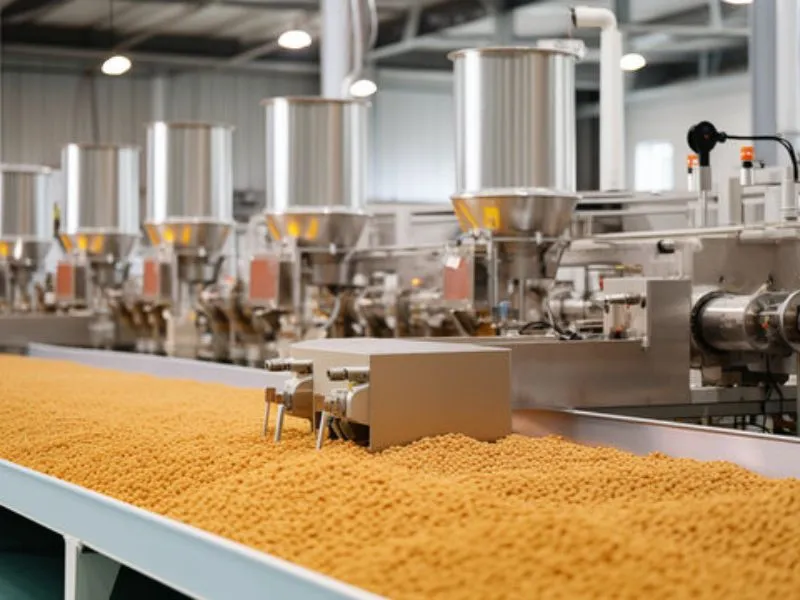
Machinery plays an important role in automating and improving the efficiency of feed production. The main equipment usually found in a feed production system includes:
- The grinder is used to crush the raw materials, increase the contact area, make the raw materials easier to mix and improve the digestibility of livestock.
- The mixer ensures that the raw materials are mixed evenly, creating a consistent mixture that meets nutritional requirements.
- The pellet press is responsible for shaping the raw materials into pellets, using pressure, temperature and steam to create binding force, ensuring that the feed pellets are stable and of uniform size.
- The packaging machine helps preserve the product, automatically packaging with high precision, ensuring easy transportation and long-term storage.
- Conveyors are used to transfer raw materials such as grains, bran, and protein from the storage area to the grinding, mixing or pelleting units. After the product is completed, the conveyor continues to support the transport of packaged feed to the storage area or truck for distribution. Using conveyor belts not only helps reduce manual labor, increase productivity, but also ensures hygiene and limits loss of raw materials during the production process.
The modernity and optimization of these devices not only help reduce production time but also improve feed quality, meeting market demand well.
The animal feed production process not only requires precision and modern technology but also needs to ensure sustainability and environmental friendliness. Investing in advanced equipment and optimizing the process will bring high economic efficiency, while contributing to building a sustainable livestock industry. If you are interested in animal feed production solutions, learn and apply the appropriate machinery and technology to achieve optimal efficiency.
