


Discover the new technology sponge cake production process
15-08-2025 911
The process of making sponge cake is not simply mixing flour and baking, but also requires precision and close coordination between ingredients, technology and techniques. With the support of modern machinery, this process becomes more efficient, ensuring that each sponge cake is of perfect quality.
Mục lục
Let's explore each step in the sponge cake production process with Intechvietnam to better understand the sophistication behind these soft and delicious cakes.
What ingredients are sponge cakes made from?
Sponge cakes are a popular sweet cake made from a number of basic ingredients, each of which plays an important role in creating the texture and flavor of the cake. The main ingredients include:
- Flour: This is the main ingredient that creates the texture of the cake. Flour helps the cake to be spongy and soft when baked.
- Eggs: Eggs help to bind the ingredients together, creating a spongy cake thanks to the ability to create foam when beaten. Eggs also provide moisture and help the cake have a beautiful yellow color.
- Sugar: Sugar not only increases the sweetness of the cake but also helps to create moisture and helps the cake rise more evenly during baking.
- Butter: Butter helps the cake become softer, creates a rich flavor and increases the moisture of the cake, preventing the cake from drying out.
- Milk: Milk provides moisture to the cake, making the cake softer and smoother, while creating a light, pleasant flavor.
- Baking powder: Baking powder helps the cake rise, creating a spongy texture for the sponge cake. When combined with moist ingredients, baking powder will produce CO2 gas, helping the cake rise during baking.
- Some other food additives according to the standards of the Ministry of Health such as leicithin emulsifier, foaming agent, preservative, flavor enhancer, colorant (tatrazine - lemon yellow), ...
- Table salt
- Each ingredient plays an important role in creating a delicious, soft and perfectly spongy sponge cake.
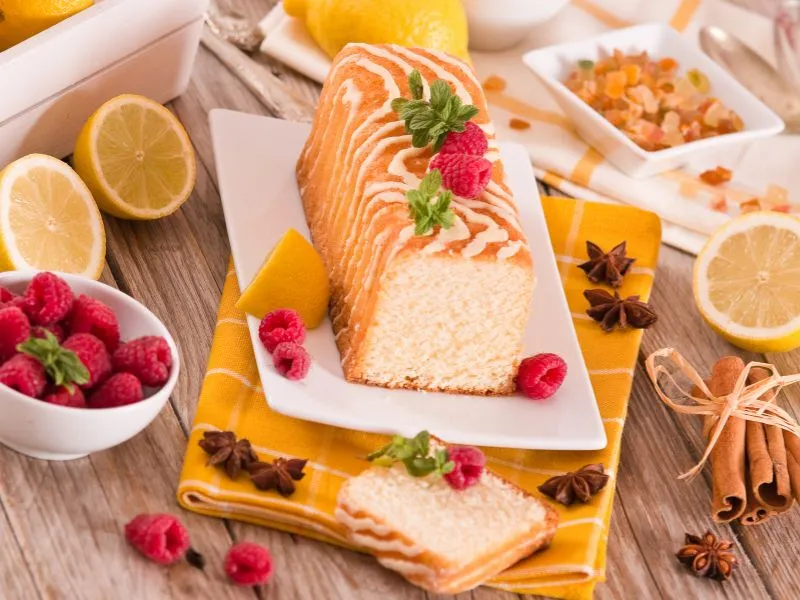
Industrial sponge cake production process
Step 1: Prepare ingredients
The first step is to prepare the necessary ingredients according to the recipe, with the exact ratio to ensure the quality of the sponge cake product. In industrial production, the ingredients are carefully preserved in specialized warehouses, such as cold storage or dry storage, to maintain freshness and quality. Modern machinery systems support automatic measurement and division of ingredients, saving time and ensuring accuracy.
Step 2: Mix ingredients
The process of mixing the ingredients helps create a homogeneous mixture, playing an important role in determining the texture and expansion of the cake:
- Beat eggs and sugar: Eggs and sugar are beaten at high speed to create a light, fluffy mixture, providing a spongy texture for the cake. In large-scale production, high-capacity machinery undertakes this step with high efficiency.
- Add butter and milk: Once the egg mixture is fluffy, melted butter or oil and milk are added to increase the richness and smoothness.
- Add flour and baking powder: Flour and baking powder are sifted and gently mixed into the mixture to ensure evenness and keep the air bubbles. The mixing process must be done carefully so as not to damage the spongy texture.
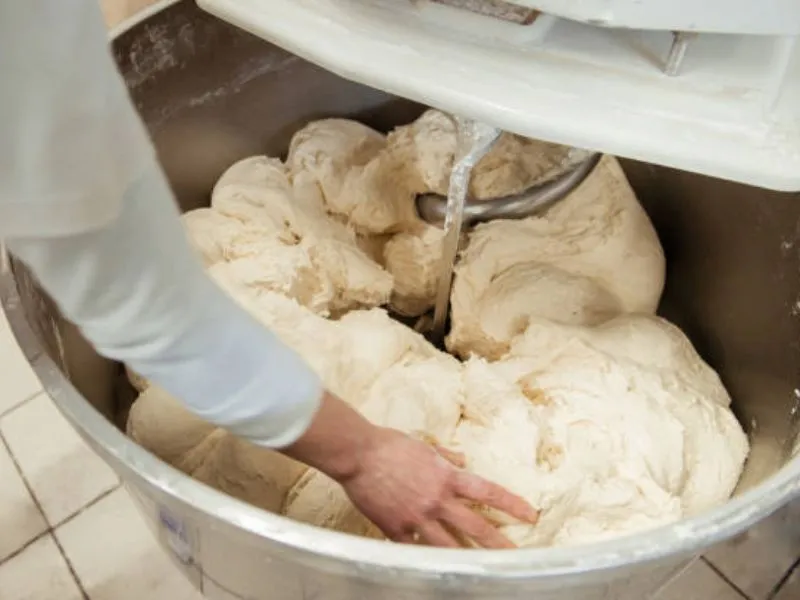
Step 3: Pouring and baking
After mixing, the flour mixture is poured into prepared molds. Molds are usually lined with parchment paper or brushed with oil to prevent the cake from sticking. In industrial production, automatic machines support precise measuring and pouring. The oven is preheated to about 170-180°C, and the cake is baked for 20-30 minutes depending on the size. Modern oven systems ensure that the cake is cooked evenly and reaches optimal quality.
Step 4: Cooling the cake
Once the cake is cooked, it is cooled to maintain its texture and flavor. In the industrial chain, the cakes are transferred through an automatic cooling system or conveyor belt to reduce the temperature quickly while maintaining stable quality.
Step 5: Packaging
Once the cakes have completely cooled, they are transferred via conveyor belt to the packaging area. Here, automatic packaging equipment will handle the packaging of the cakes into bags, paper boxes, or plastic packaging depending on the preservation requirements. Modern technology ensures that the packaging process is fast, discreet, and maintains product quality, while protecting the cakes from the impact of the external environment.
Step 6: Quality control
Before being released to the market, cakes must undergo a rigorous quality assessment process. Indicators such as softness, taste, color, size, and expansion are all carefully considered. To ensure accuracy, the inspection process is carried out using both automatic equipment and manual inspection by a team of specialized staff.
Step 7: Storage and distribution
After packaging, the cakes are stored in a suitable environment, such as a regular warehouse or cold storage if necessary. Storage conditions are always controlled to keep the cakes fresh and prolong their shelf life. Finally, the cakes are transported to distribution points such as supermarkets, stores or e-commerce platforms, ready to reach consumers.
Machinery used in the sponge cake production process
In the sponge cake production process, modern machinery plays an important role in automating, increasing efficiency and ensuring product quality. Below are some of the machines commonly used in the sponge cake production line:
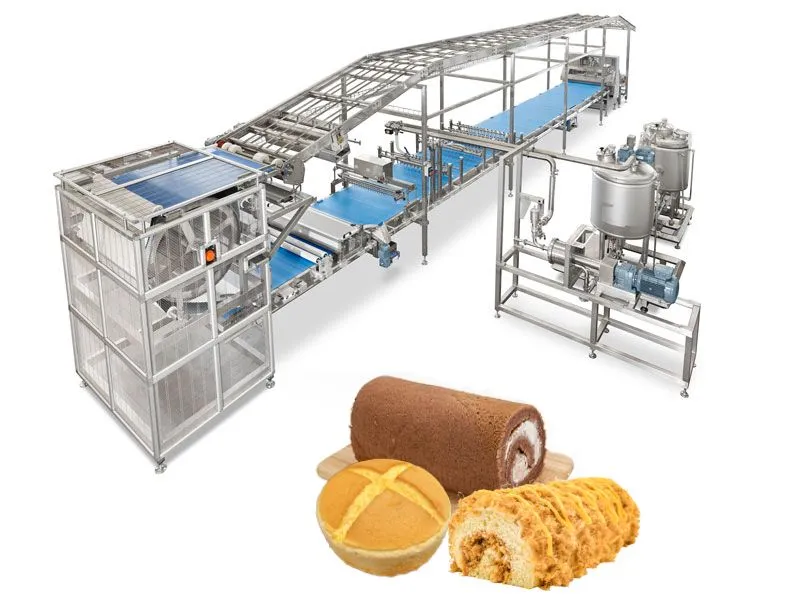
- Dough mixer: Mix ingredients such as flour, eggs, sugar, butter, and milk to create a smooth, uniform dough mixture. Ensure the cake has a soft and fluffy texture after baking.
- Automatic oiling machine: Automatically brush oil or spread non-stick coating on the cake mold. Helps the cake easily escape from the mold after baking, keeping its shape and quality.
- Automatic forming and filling machine: Shapes and distributes dough into the mold in the correct proportion. Increases uniformity in size and shape of the cake, saving time compared to manual work.
- Automatic sugar or sesame sprinkler: Sprinkle sugar, sesame, or other toppings evenly on the surface of the cake before baking. Increases the aesthetics and characteristic flavor of the cake.
- Tunnel Oven: Bakes cakes in a continuously controlled temperature environment. Ensures cakes are baked evenly and achieves stable quality in large-scale production.
- Rotating mold rack: Holds the cake mold during baking, can be rotated to ensure even temperature distribution. Ensures cakes are cooked evenly from all sides, avoiding the phenomenon of burnt or undercooked cakes.
- Cooling equipment: Cools cakes after baking through a conveyor system or fan. Keeps the cake structure stable, avoids steaming and ensures cakes are ready for the next steps.
- Automatic filling sandwicher: Automatically adds fillings such as cream, jam or chocolate between two cake layers. Increases convenience and uniformity for products with fillings.
- Automatic cake mold release machine: Separates cakes from the mold without damaging the shape of the cake. Improves efficiency and minimizes losses due to cake damage.
- Automatic cake tray cleaning device: Cleans the cake tray after use, preparing for the next production. Ensure food safety and increase production speed.
- Conveyor belt: Conveyor belt helps move and distribute cakes between production stages. Helps the production process to be continuous, minimizing manual labor.
- Automatic packaging machine: Packs cakes into bags or boxes quickly and accurately. Protects cakes from environmental impacts, maintains product quality and increases professionalism.
Modern machinery systems not only help optimize productivity but also ensure that each sponge cake is produced with consistent quality, meeting consumer standards and tastes.
The sponge cake production process is not only a combination of technology and technique but also demonstrates dedication to bringing perfect products to consumers. From preparing ingredients, mixing dough, baking cakes to packaging and distribution, each step plays an important role in ensuring the quality and excellent taste of the cake. Thanks to the application of modern technology, the sponge cake manufacturing industry is increasingly developing, meeting the diverse needs of the market.
The sponge cake production process is not only a combination of technology and technique but also demonstrates dedication to bringing perfect products to consumers. From preparing ingredients, mixing dough, baking cakes to packaging and distribution, each step plays an important role in ensuring the quality and excellent taste of the cake. Thanks to the application of modern technology, the sponge cake manufacturing industry is increasingly developing, meeting the diverse needs of the market.
