


Discover the sterilized milk production process from A to Z
15-08-2025 1.069
The sterilization milk production process plays an important role in providing consumers with high-quality, safe and nutritious milk products. Thanks to modern technology and strict processing steps, sterilization milk not only retains its nutritional value but also has a long shelf life, meeting the needs of every family.
Mục lục
Understanding Sterilized Milk
Sterilized milk is divided into two main types: sterilized fresh milk and sterilized reconstituted milk. The important difference lies in the production materials. Sterilized fresh milk is made entirely from fresh milk, while sterilized reconstituted milk is produced by mixing milk powder with water and adding other nutrients and additives.
To clearly distinguish between these two types of milk, consumers should pay attention to the information about the ingredients on the product packaging. This is a simple and effective way to determine the origin of each type of milk. Currently on the market there are many types of sterilized milk from famous brands such as: Vinamilk, TH True Milk, Dalatmilk, Dutch Lady, Nutri Milk, ...
Sterilized fresh milk is processed with modern technology at high temperatures from 138 - 141°C in a very short time, about 3 - 5 seconds. The milk is then rapidly cooled and packaged in sterilized packaging, which helps to kill all harmful bacteria and extend the shelf life to 6 - 8 months.
Thanks to the rapid heat treatment process, sterilized fresh milk retains almost all of its natural nutrients. Some of the prominent ingredients in milk include protein, calcium, DHA, vitamins A, B, C, D and other essential minerals, providing many health benefits.
Sterilized fresh milk is suitable for adults and children from 1 year old and up. However, for children from 1 to 2 years old, pasteurized milk may be a better choice because it helps the body absorb nutrients more easily and stably.

Steps in the sterilization milk production process
Step 1. Receiving and checking the quality of raw milk
Milk collected from the facilities will be transported to the factory by specialized vehicles with insulated tanks, maintaining the temperature below 6°C to limit the growth of microorganisms and prevent their intrusion during transportation.
When the milk arrives at the factory, QA staff will conduct a quality check. If it meets the standards, the milk will be pumped through a pipe system with a metal filter (150µm filter hole diameter) to remove impurities, and through a flow meter to determine the volume of milk received. After that, the milk is cooled and stored.
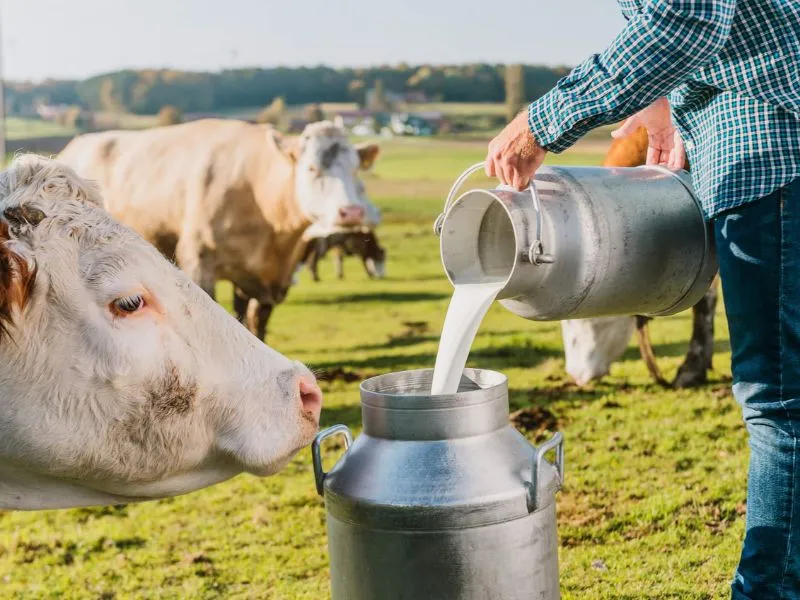
- Cooling and storing milk
Milk is maintained at a temperature of 4 - 6°C until it is processed, to inhibit the activity of microorganisms and preserve quality. After filtering, the milk will be passed through a cooling compartment using salt water in a plate heat exchanger. When the required temperature is reached, the milk will be pumped to specialized tanks (xitec) for storage. Storage time depends on the temperature and environmental conditions at the storage location. QA staff will periodically check the storage temperature to ensure quality.
- Heating
Milk from the tank is pumped through a plate heat exchanger to increase the temperature to about 40°C. This is a preparation step to facilitate the centrifugation cleaning process.
- Centrifugal cleaning
Milk is passed through a centrifuge to remove residue, Soma cells, and dead microorganisms, ensuring the highest quality raw milk. Thanks to centrifugal force, unwanted impurities are separated from the milk solution.
Step 2. Mixing
Stabilizers are precisely measured according to the formula of each processing batch. Milk is pumped into a mixing tank with a capacity of 500 - 600 liters, then heated to 65 - 70°C to dissolve the substances. The milk circulation process takes place through the almix unit. Then, the milk temperature is reduced to 40 - 45°C to mix the sugar. The final milk mixture is transferred to the buffer tank to continue the next processing steps.
Step 3. Cooling and standardization
- Cooling
The milk mixture after mixing is pumped to the cooling system to cool the temperature down to ≤ 8°C and stored in buffer tanks. Cooling helps prevent spoilage and maintain the quality of milk during further processing.
- Standardization
The standardization process adjusts the content of ingredients in milk to ensure that the final product meets the quality criteria announced by the factory. In practice, most fresh milk already meets the standards for dryness (11.75%) and fat content (3.5% ± 0.1%), so this step is not necessary.
However, if the dry or fat content does not meet the requirements, the milk will be adjusted by adding water (if the dry fat content is too high) or adding ingredients such as sugar, milk powder, or avocado oil to meet the standard level. After standardization, flavoring will be added before the QA staff checks the sensory and approves the next step.
Step 4. Homogenization and sterilization
- Homogenization
Homogenization helps reduce the size of the fat globules in the milk, increases the ability to disperse evenly and prevents the phenomenon of floating on the surface during storage. The milk is heated at 70-75°C through a heat exchanger, using the heat from the milk after sterilization to save energy.
- UHT sterilization
Milk is sterilized at ultra-high temperature (Ultra-High Temperature - UHT) to completely destroy harmful microorganisms, spores and enzymes. This process extends the shelf life of milk to 6 months at room temperature without significantly changing the natural properties of the product thanks to the short processing time.
Step 5. Aseptic filling
To ensure that the product is not contaminated with impurities or microorganisms from the outside environment, the filling process is carried out in a closed, sterile system. The packaging (roll paper) before packaging is sterilized with a 35% concentration of H₂O₂ solution at 70°C, combined with ultraviolet radiation for 4 seconds. Then, the machine automatically performs the filling process, seals the straw and transfers the product via conveyor to the packaging area.
Milk is poured into standard volume (200ml) in a sterile environment, ensuring that all equipment and packaging are in perfect sterilization condition.
Step 6. Packaging and finishing the product
The finished product will be transferred via conveyor to the packaging area. Workers arrange the milk cartons into packs of 4 cartons, then pack them into 12-pack containers. Each carton is clearly printed with information about the production date, expiry date, product code, and brand name. UHT sterilized milk can be stored at room temperature for 6 months.
Although the production process of sterilized milk may vary depending on the brand, the above basic steps are always applied to ensure that the final product meets the highest quality standards.
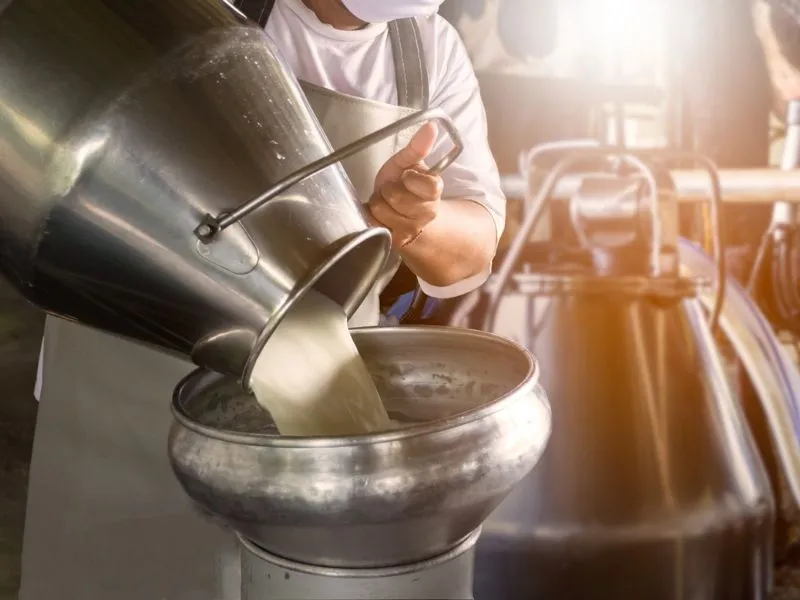
Optimizing the sterilized milk production process with modern production lines
In the sterilized milk production process, some key machines play an important role in each stage such as:
- Milk collection and storage equipment, including tank trucks with insulated tanks, ensures the milk temperature is below 6°C during transportation to limit the growth of microorganisms.
- The filter and chiller are responsible for removing initial impurities and reducing the milk temperature to 4 - 6°C to maintain quality before processing.
- The plate heat exchanger is an important device in the heating stage, helping to heat the milk to the desired temperature (usually 40°C) to prepare for the centrifugation process.
- The centrifuge is responsible for removing dirt, Soma cells and dead microorganisms, ensuring the milk is clean before entering the next steps.
- During the UHT sterilization process, the high-temperature sterilization equipment heats the milk to 138 - 141°C for 3 - 5 seconds, completely destroying harmful bacteria while still retaining nutrients.
- The conveyor system helps transport raw materials, packaging and products between stages quickly and accurately, minimizing waiting time and optimizing productivity. During the packaging stage, the conveyor helps to stably bring the sterilized packaging into the milk filling machine, ensuring that it is not displaced or contaminated.
- The aseptic filling and packaging machine ensures that the milk is packaged in a closed environment, preventing the penetration of microorganisms and impurities, while extending the product's shelf life up to 6 months at room temperature.
The sterilized milk production process is not only a combination of advanced technology but also a commitment to quality and safety from manufacturers. Each stage, from receiving raw materials to packaging products, is carefully carried out to bring the best products to consumers.
