


Explore the plastic cup production line from A to Z
12-08-2025 860
The demand for plastic cups in daily life and production is increasing. To meet the demand for large quantities and ensure product quality, businesses have invested in modern production lines. This system not only helps to increase productivity but also optimizes costs and creates high-standard products for consumers.
Mục lục
What is a plastic cup production line?
A plastic cup production line is a system of equipment and machinery that are arranged and operated in a continuous process, from raw material processing to shaping, printing, quality control and packaging of finished products.
This system operates automatically or semi-automatically, helping to optimize the production process, increase productivity and ensure consistency in the quality of plastic cups. The plastic cup production line not only helps businesses meet market demand but also saves labor costs, improves production efficiency and increases competitiveness in the market.
Main materials in the plastic cup production line
Disposable plastic cups are popular products made from plastics or plastics, often used to hold drinks. Although they appear simple, the production process of this type of cup requires meticulousness and strict control at each stage. The efficiency and speed of production depend significantly on the quality of input materials.
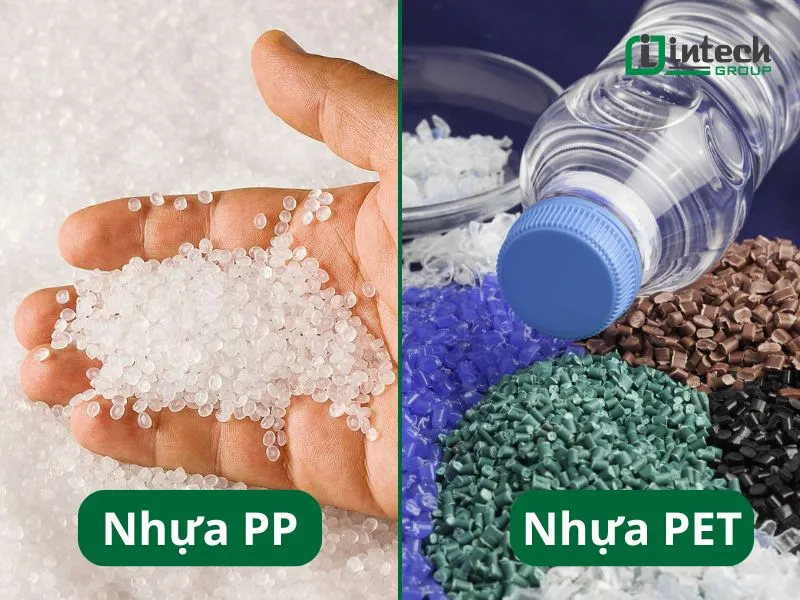
The main raw materials for producing plastic cups are usually virgin PP and PET plastic, which are highly appreciated for their safety for health and do not contain harmful substances.
- PP (Polypropylene) plastic: This type of plastic is smooth, sturdy, and very difficult to tear. Cups made from PP plastic are usually transparent, slightly shiny, colorless, odorless or tasteless. In addition, PP plastic has excellent water resistance.
- PET (Polyethylene Terephthalate) plastic: This is a thermoplastic with high durability. Cups made from PET plastic are usually slightly opaque, harder, and have a slight squeak when touched. In particular, PET plastic has better heat resistance than PP plastic, increasing its application in the production of multi-purpose plastic cups.
How does the plastic cup production line work?
The plastic cup production line operates in a closed process, including the following main stages, each stage using specialized machinery:
- Extrusion
The plastic cup production process begins with the extrusion stage, an important step in converting plastic pellets into the desired form. In the extruder, plastic pellets are heated until they reach a molten state, allowing a continuous strip of plastic to be formed. This molten strip is forced through a die, forming a thick plastic sheet.
The thickness of the plastic sheet can be adjusted to suit the requirements for durability and intended use of the final product. Thicker sheets are often used to make heat-resistant cups, suitable for hot drinks, while thinner sheets are suitable for cups containing cold drinks. The flexibility in adjusting the thickness allows manufacturers to create a variety of plastic cups, meeting the different needs of consumers, while ensuring superior quality and functionality.
- Thermoforming
After the extrusion stage, the manufacturing process moves to the thermoforming stage, where the plastic sheet is heated to its plastic temperature and shaped into a plastic cup. This stage includes a variety of techniques, the most common of which are vacuum forming and pressure forming.
In the vacuum forming method, the heated plastic sheet is placed on a mold, which is then vacuum-drawn into the corners of the mold.
In contrast, the pressure forming method uses high pressure to press the hot plastic sheet into the mold. This method is often applied to complex or detailed-patterned plastic cup designs.
Thermoforming plays an important role in transforming the flat plastic sheet into the desired cup shape, creating a foundation for the next steps, while ensuring the product meets functional and aesthetic standards.
- Cutting and quality control
After the plastic cup has been shaped, the cutting process will take place to remove excess, ensuring that the cup rim is even and complete. This is a stage that requires high precision, playing an important role in maintaining the uniformity and quality of the product.
Next, the plastic cup is strictly tested for quality to ensure that it fully meets the manufacturer's strict criteria for durability, load-bearing capacity and aesthetics.
Only plastic cups that pass this rigorous inspection process are transferred to the next production stage. The strict quality control process not only ensures the reliability and durability of the product but also affirms the manufacturer's commitment to providing customers with products that are superior in quality.
- Printing and decoration
The printing and decoration stage plays an important role in enhancing the aesthetics and brand value of plastic cups. Techniques like screen printing, offset printing or digital printing are used to customize mugs with logos, designs or messages as per the business requirements.
This personalization helps brands enhance their brand recognition through product packaging. Through unique images on plastic cups, businesses not only make their products more attractive but also create a deep connection with customers. This leaves a lasting impression, far beyond the simple function of plastic cups, contributing to strengthening brand recall in the minds of consumers.
Printing and decoration therefore become powerful tools to help businesses create a distinct mark in the market and enhance the overall brand image.
- Packaging and distribution
Packaging and distribution is the final step in the journey of manufacturing plastic cups. Here, plastic cups are carefully packaged to prepare for shipping. Typically, plastic cups will be arranged in large bags or boxes, tightly organized to optimize space and minimize the risk of damage during shipping.
These packages are then sent to distributors or customers through an efficient logistics network.
Ensuring the integrity of the packaging is key, protecting the cups throughout their journey, ensuring that the product reaches the consumer in perfect condition. From the manufacturing plant to the end user, every step in the distribution process is closely coordinated to ensure that the plastic cups arrive at the right destination, ready to serve the needs of use.
Machinery in the plastic cup production line
A complete production line usually includes many types of machinery that operate closely together, from raw material processing to finished product packaging.
- Plastic extrusion machine
This is the first equipment in the line, responsible for melting and extruding plastic into continuous sheets. Plastic granules (such as PP, PET) are heated until they reach a liquid state, then pressed through a mold to create plastic sheets of the appropriate thickness.
- Thermoforming machine
After the plastic sheet is pressed out, the thermoforming machine will heat the plastic sheet to a flexible state, then press it into the mold to form the plastic cup. The two common technologies are vacuum forming and pressure forming, which help ensure that the products have precise and beautiful shapes.
- Cutting machine
This machine is responsible for removing the excess edge around the plastic cup after forming, helping the product to have complete lines and a smooth surface, ensuring high aesthetics.
- Printing and decoration machine
To increase the aesthetic value and create a brand impression, silk screen printing, offset printing or digital printing machines are used to print logos, patterns, or information on the surface of plastic cups.
- Quality inspection machine
Some modern production lines use automatic scanning systems to detect product defects such as cracks, uneven surfaces or printing errors.
- Packing machine
This is the last equipment in the chain, which is responsible for arranging and packing plastic cups into boxes or large bags. The machine helps to optimize the packing space and protect the product before shipping.
- Conveyor
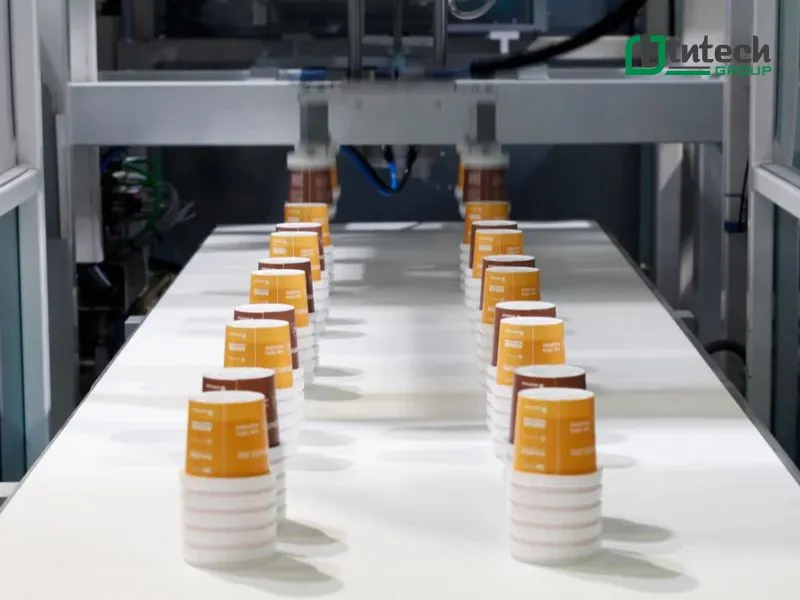
The conveyor helps to move plastic sheets, shaped plastic cups or finished products from one machine to another quickly and stably, completely replacing manual methods that are time-consuming and labor-intensive. With the function of automatically and continuously transporting finished products or raw materials through stages, the conveyor helps to optimize the production process, save time and improve productivity.
Thanks to the close combination of these advanced machines, the plastic cup production process becomes faster, more efficient and cost-effective. This not only meets the increasing demands of the market but also contributes to improving the competitiveness of manufacturing enterprises.
In summary
The plastic cup production line is a testament to the advancement of technology in the plastics industry. Thanks to modern machinery systems and automated processes, businesses not only meet market demands but also contribute to building a more sustainable, efficient and competitive production base in an increasingly developing economic context.
