


Learn about industrial sewing lines in the most detail
13-08-2025 453
Industrial sewing lines play an important role in the garment industry, helping to optimize the production process and meet the increasingly diverse needs of the market.
Mục lục
From small-scale factories to large corporations, the application of industrial sewing lines has brought about remarkable advances in productivity, quality and cost.
Main components of industrial sewing lines
- Machinery and equipment
Machinery and equipment are the "backbone" of industrial sewing lines, ensuring fast and consistent production performance. The types of machinery used in sewing lines are often very diverse, suitable for each stage of the production process:
- Industrial sewing machines: This is the core equipment, including many different types such as straight sewing machines used to perform basic seams, overlock machines to handle fabric edges, buttonhole machines to create precise and beautiful buttonholes, or automatic cutting machines to cut fabric quickly, saving time and materials.
- Automatic conveyor belts and material transfer systems: These are tools that support the movement of raw materials, semi-finished products or finished products from one stage to another. Automatic conveyor belts not only help increase production speed but also minimize errors and reduce human labor.
With the development of technology, many modern machines and equipment have been integrated with artificial intelligence (AI) and the Internet of Things (IoT) to optimize processes and easily monitor remotely.
- People
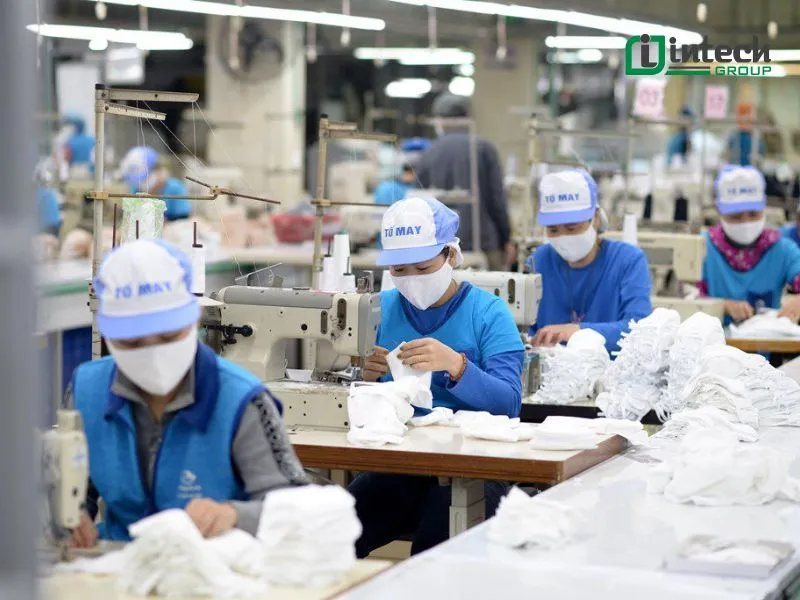
Besides machines, the human factor is also an indispensable component in the industrial sewing line. Despite the support of automation technology, the role of humans is still very important to ensure the stable and efficient operation of the line.
- Workers and technicians: Workers are the ones who directly operate the machines, perform the sewing, assembly, and product inspection stages. They need to have quick, precise operating skills and strictly adhere to technical standards. In addition, technicians play a role in technical support, maintenance and troubleshooting of machinery and equipment in the production line.
- Role of production manager: Production managers are responsible for coordinating and supervising the entire production line. They must ensure that production stages are carried out on schedule, product quality meets requirements and resource waste is minimized. In addition, production managers are also responsible for training employees, planning production and optimizing processes to increase productivity.
The combination of modern machinery and equipment and qualified human resources is the key to the success of industrial sewing lines. While machinery ensures high performance and precision, people are the flexible factor that helps handle complex situations and operate the line effectively. Both of these factors need to be invested in and developed synchronously to meet the increasing demands of the global garment market.
Industrial Sewing Line Operation Process
The industrial sewing line operation process is divided into main stages, each stage uses specialized machines and is connected to ensure efficient production.
Step 1: Prepare raw materials
The production process begins with the preparation of raw materials. This is the fundamental step to ensure the quality of garment products. Raw materials such as fabric, thread, accessories (buttons, zippers, labels) are purchased and carefully inspected before being put into the line.
In this step, raw materials need to be classified and pre-cut according to design requirements. At the same time, the technical team checks the quality of the fabric to detect errors such as torn, faded or substandard fabric. Preparing raw materials completely and accurately helps minimize the risk of interruption in the next steps.
Step 2: Cut fabric
After the raw materials are prepared, the next step is to cut the fabric. This is an important step in shaping the parts of the garment product.
Normally, the fabric is spread flat and cut according to the design using an automatic cutting machine or laser cutting machine. Modern cutting technology ensures high precision, minimizing fabric waste. The fabric layers are cut on top of each other to increase production speed. Each cut detail is marked for easy assembly in the next stages.
Step 3: Assembling and sewing the finished product
Assembling and sewing the finished product is the main stage in the industrial sewing line, where the fabric details are joined to form the finished product. This stage is performed by specialized industrial sewing machines such as straight sewing machines, overlock machines, or buttonhole machines, depending on the requirements of the product.
Workers on the line are clearly assigned, each person is responsible for a specific stage such as assembling the shirt body, sewing pockets, or attaching accessories. The assembly process is carried out step by step, ensuring fast speed and consistent quality. The coordination between humans and machines in this stage is the decisive factor for productivity and production efficiency.
Step 4: Quality Control (QC)
The final step in the operation process is product quality control, often called QC (Quality Control). This is an important step to ensure that the product meets the standards before reaching the customer.
During the inspection process, the product is comprehensively reviewed, from the quality of the seams, the durability of the accessories to the aesthetics such as color and style. Products that do not meet the standards will be repaired or removed to ensure that they do not affect the reputation of the business.
In addition to manual inspection, many modern sewing lines apply automatic inspection systems using scanners or AI cameras, helping to detect errors more quickly and accurately.
Benefits of using industrial sewing lines
Using industrial sewing lines brings countless benefits that are superior to manual or small-scale sewing methods.
- Increase production productivity
One of the biggest benefits of using industrial sewing lines is increased production productivity. Thanks to automation and process optimization, businesses can produce at a faster rate than traditional manual methods.
Modern machines such as automatic cutting machines, multi-function sewing machines and automatic conveyor belts help reduce the time to perform each stage. At the same time, the smooth coordination between stages in the chain helps reduce congestion or delays. Thanks to that, businesses can meet large orders in a short time while still ensuring product quality.
- Reduce labor costs
Industrial sewing lines also help reduce dependence on manual labor, thereby saving labor costs. Instead of needing a large number of workers to perform each individual stage, automatic machines can replace most of the repetitive operations.
This not only reduces salary costs but also reduces related costs such as training, management and labor insurance. With the use of machines, businesses can focus on improving the technical level of a small number of operating staff, helping to increase work efficiency without increasing the number of workers.
- Improve product quality
Product quality is a vital factor for any business in the garment industry. Using an industrial sewing line makes quality control easier and more consistent than manual production methods.
Automatic equipment is programmed to perform precise operations, ensuring that each seam and stitch meets standards. In addition, the automatic or semi-automatic quality control process helps detect errors early, minimizing defective or returned products. Thanks to that, businesses not only meet customer requirements but also build brand reputation.
- Environmentally friendly
Another important benefit of an industrial sewing line is its environmental friendliness. Modern technologies are designed to save energy, minimizing electricity consumption compared to traditional equipment.
In addition, automatic cutting systems and conveyor belts help use raw materials efficiently, minimizing waste of fabric and accessories. Some lines also integrate smart waste treatment technology, ensuring minimal impact on the surrounding environment. This not only helps businesses comply with environmental standards but also enhances their social responsibility.
Popular types of industrial sewing lines
There are many popular types of industrial sewing lines, classified based on their structure, level of automation and the type of garment products they produce. Here are some of the main types:
- Traditional sewing lines
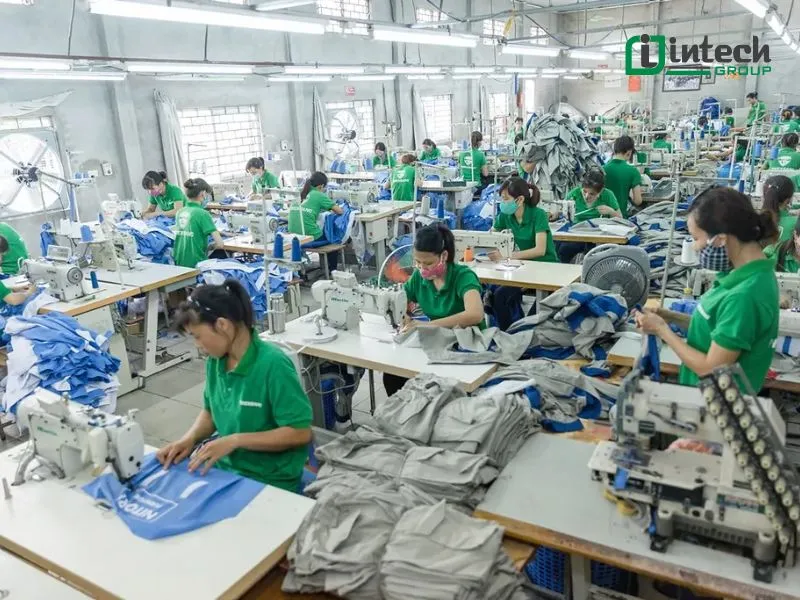
Traditional sewing lines are a long-standing production model, in which workers undertake specific stages according to a fixed process. This type of line is common in small businesses or areas that have not yet applied much modern technology.
Characteristics: The stages are performed manually or by basic machines. Workers specialize in each stage such as cutting, sewing, assembling or checking.
Advantages:
- Easy to deploy, does not require large investments in modern machinery.
- Flexible in changing product design and model.
Disadvantages:
- Lower efficiency than modern models.
- Highly dependent on worker skills, prone to errors and unevenness.
- Highly automated production line
Highly automated production line is an important step forward in the garment industry, applying modern technology and automatic machines to perform most stages.
Features: Automatic machines perform operations such as cutting, sewing, folding, or checking products. Workers mainly take on the role of supervising and operating machines.
Advantages:
- Significantly increase productivity, reduce production time and labor costs.
- Consistent product quality, minimizing errors.
Disadvantages:
- Requires large initial investment capital to purchase equipment and train employees.
- Lack of flexibility in producing small orders or complex designs.
- Flexible modular production line
Flexible modular production line is an advanced production model that allows stages to be flexibly connected, suitable for orders with diverse requirements.
Features: The production process is divided into independent modules, each module is responsible for a part of the product. Workers in a module can take on many different roles.
Advantages:
- Easily adaptable to changes in designs or market demand.
- Reduce pressure on workers, increase creativity and improve the working environment.
Disadvantages:
- Requires high skills from workers.
- Need a more complex management system to coordinate between modules.
- Lean production system (lean production)
The Lean method, or lean production, focuses on optimizing the production process by reducing waste and increasing value. This model is widely applied in large enterprises, especially those aiming for sustainable production.
Characteristics: Using the "Just-in-Time" principle to minimize inventory. The stages are optimized to eliminate unnecessary operations.
Advantages:
- Reduce costs and increase productivity.
- Improve product quality and delivery time.
- Environmentally friendly thanks to reduced waste of raw materials and energy.
Disadvantages:
- Requires investment in management systems and personnel training.
- Depends heavily on the ability to coordinate between departments.
Summary
The development of industrial sewing lines has completely changed the way of production in the garment industry, bringing many outstanding benefits from high productivity, consistent product quality to cost savings and environmental protection.
With the continuous improvement of technology and application of modern production models, industrial sewing lines are not only the driving force for the development of the garment industry but also contribute to enhancing the position of enterprises in the international market. This is the key to opening the door to success in the era of industrialization and globalization.
