


Learn the glass manufacturing process from A to Z
15-08-2025 899
Glass is one of the familiar materials and is widely used in life, from household appliances, decoration to the industrial field. However, not everyone clearly understands the glass production process ?? a series of meticulous and complex stages to create durable, transparent and high-quality products.
Mục lục
Let's explore each step in the glass production process in detail through the article below.
Learn about the properties of glass
Glass, commonly known as glass or ornamental glass, is a solid with the chemical formula SiO2 and does not have a characteristic crystalline structure. With the main component being silicate, glass is capable of withstanding high temperatures, can be melted at about 2000 degrees Celsius (3,632 °F) and is easily shaped according to the manufacturer's ideas.
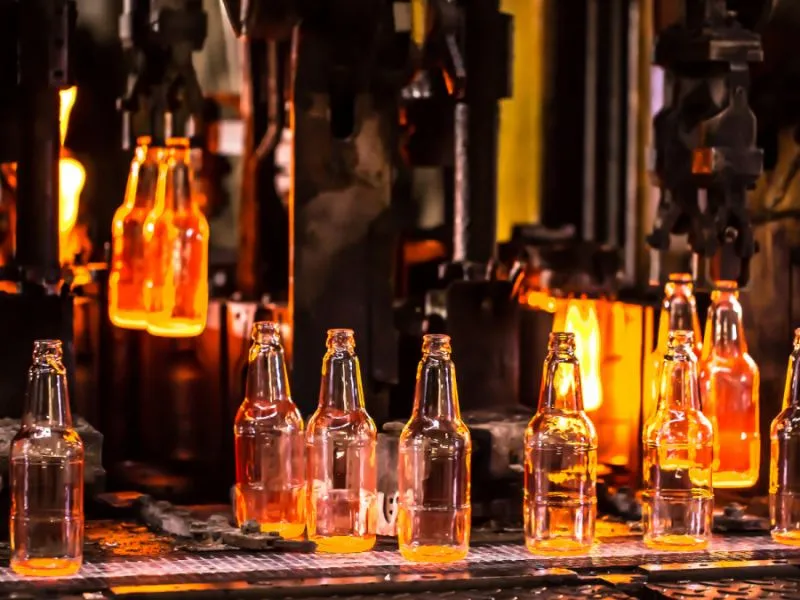
Glass products have many outstanding features such as:
- Has a colorless, transparent appearance, is quite hard, is not corroded and has good light transmission.
- Easy to clean, does not retain odors.
- Suitable for processing processes such as painting or plating.
- Although hard, it is fragile when subjected to strong impacts.
- Can be recycled and reused, contributing to environmental protection.
What is glass made from?
Glassblowing techniques began to develop in the first century BC. The Roman Empire saw the appearance of various glass products, mainly vases and bottles.
Glass is mainly composed of silicates with the chemical formula SiO2, which exist in nature in polycrystalline form such as sand and are the main component of quartz. Silicates have a melting point of about 2,000 °C (3,632 °F), requiring a lot of energy to melt and shape.
During the production process, manufacturers often add manganese dioxide to adjust the color in case standard silica sand is not available. In addition, additives such as limestone (Sodium carbonate - Na₂CO₃) and calcium oxide (CaO) are also mixed with sand, accounting for about 26-30% of the glass compound.
Sodium carbonate (Na₂CO₃) plays a role in reducing the melting temperature, saving energy and facilitating the glass making process. Depending on the intended use, manufacturers can add many different types of raw materials and chemicals to improve the properties of glass, meeting specific requirements.
Steps in the glass production process
Step 1. Forming liquid glass
The process of creating transparent glass requires precise and complete preparation of raw materials. The main ingredients include silica sand (SiO2), sodium oxide (Na2O) from soda ash, calcium oxide (CaO) from limestone, dolomite (MgO) and feldspar (Al2O3). These raw materials are crushed and mixed in a predetermined ratio.
During production, the sand is cleaned many times to remove impurities, especially iron. The presence of iron can cause the finished glass to have a green color. In cases where iron is difficult to detect, manganese dioxide is added to adjust the color of the glass.
The raw material mixture is then melted in a furnace at temperatures up to 1500 degrees Celsius to create liquid glass.
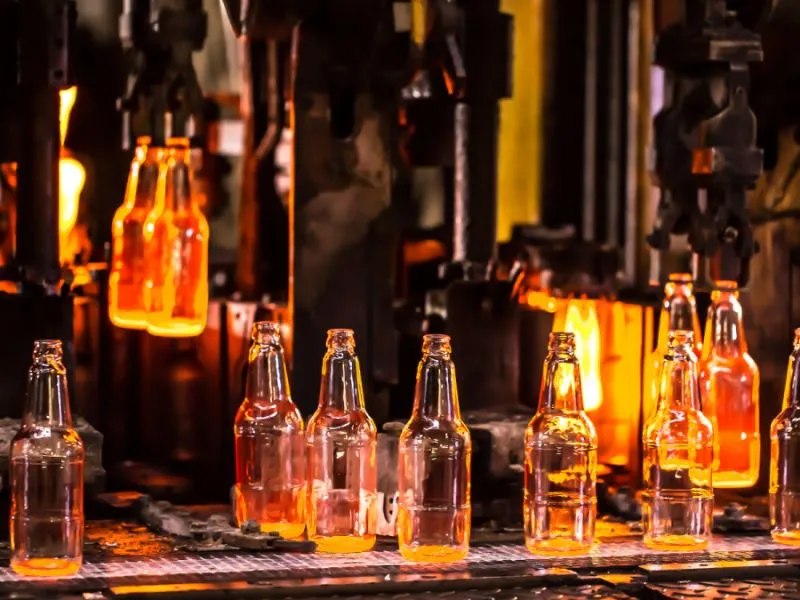
Step 2. Pouring and shaping
After heating, the liquid glass is cooled slightly to make it easier to put into the mold. However, at this stage, it remains in a liquid state for easy shaping.
The molten glass is poured into molds with predetermined shapes, and inert gases (such as nitrogen) are used to shape the product.
Depending on the intended use, the manufacturer will create glass products such as cups, mugs, bowls, etc. with diverse colors and sizes to meet market demand.
Step 3. Annealing and cooling
After shaping, the glass is put into a conveyor system to cool slowly, starting from the high temperature zone to the lower temperature zone. This process, called annealing, reduces internal pressure and increases the strength of the product.
If the glass is cooled too quickly, it will become brittle and break easily, so this process must be carried out carefully to ensure the quality of the finished product.
Step 4. Check the quality of the glass
Before becoming a finished product, the glasses you use every day must undergo a rigorous testing process. Glass production equipment must perform millions of tests to ensure the quality of the product is as pure and transparent as possible.
During the testing process, factors such as the presence of air bubbles in the glass, as well as the stability of the temperature and performance throughout the production process will be carefully evaluated.
Step 5. Finishing the glass product
After being tested, the glass products will continue to be heated to improve their strength. This process, called tempering, helps to remove any weaknesses or defects that may form during the cooling of the glass. When finished, the product will be coated with a special coating to increase the hardness and flexibility of the bottle, giving the final product more durability.
How to make glass by hand
Currently, the method of making glass by hand is mainly preserved in traditional craft villages or families with long-standing experience. This production process requires the skill, meticulousness and high skills of the craftsman. Therefore, the production time is often long and the number of products is quite limited. The basic process includes the following steps:
- First, the raw materials need to be carefully selected and screened, in which white sand is the main ingredient. This is an important step to create beautiful and quality products.
- The raw materials are put into a coal-fired furnace for about 10 hours at a high temperature of up to 2,000 degrees Celsius to create liquid glass.
- The liquid glass is pre-cooled with water, then the craftsman uses a blower to shape it. Rotating and blowing glass requires good health and skillful skills because it requires continuous manipulation to ensure the product is even and beautiful.
- When the glass is still soft and flexible, the craftsman will quickly shape it according to the desired design using skillful techniques.
- The shaped product is gradually cooled to complete.
- Finally, the product will go through a quality control process, carefully packaged and ready to be put on the market.
In the context of a constantly developing society, traditional manual methods are gradually becoming obsolete in the face of industrialization and modernization trends. As the demand for glassware increases, the application of advanced technology and modern science in production becomes inevitable, meeting today's market more effectively.
The new glass production process is the application of modern technology and sophisticated manual techniques. Thanks to continuous improvement, the glass industry is increasingly meeting the diverse needs of people.
The new glass production process is the application of modern technology and sophisticated manual techniques. Thanks to continuous improvement, the glass industry is increasingly meeting the diverse needs of people.
