


Optimizing chili sauce production process with modern machinery
16-08-2025 316
For the production process of chili sauce, a familiar spice in Vietnamese cuisine, optimization with modern equipment not only helps to increase productivity but also ensures product quality. This is a key factor to help businesses meet increasing market demand, while minimizing costs and maximizing production efficiency.
Mục lục
Overview of the current chili sauce market
Chili sauce has long been a familiar dipping sauce, appearing in most families and restaurants. This spice is commonly used with many dishes such as fried chicken, pho, hu tieu, fried rice, etc. The combination with chili sauce makes the dishes more attractive, rich in flavor and stimulates the taste buds.
According to a report from Euromonitor, the market for the condiment industry is worth about 33.5 trillion VND, of which dipping sauce accounts for 64%. In the dipping sauce segment alone, fish sauce ranks first with a total scale of 15 trillion VND, followed by soy sauce (2.8 trillion VND) and chili sauce (2.6 trillion VND).
In Vietnam, Chin-Su is dominating the chili sauce market with 60% market share, the rest are other brands such as: Cholimex, Vifon, Sriracha, Nam Duong,.... Not only successful domestically, Vietnamese chili sauce products are also exported to many international markets such as North America, Europe, Australia, China, Korea, Japan,....
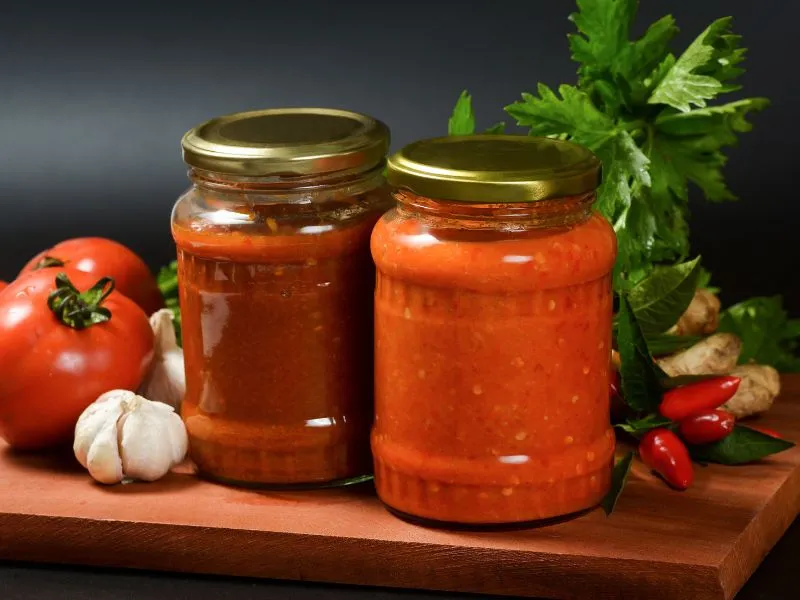
What ingredients are chili sauces made from?
Chili sauces are usually made from main ingredients such as:
- Fresh chili: The main ingredient that creates the characteristic spicy taste.
- Garlic: Enhances the delicious flavor.
- Salt: Used to preserve and balance the flavor.
- Sugar: Creates natural sweetness.
- Vinegar: Adds a slight sour taste and aids in preservation.
- Water: Helps adjust the thickness of the sauce.
In addition, some types of industrial chili sauce can add ingredients such as stabilizers, preservatives, or food coloring to make the product have a more stable flavor and color.

Chili sauce production process
The steps in the chili sauce production process are as follows:
- Select and prepare raw materials
The main ingredients include fresh chili, garlic, salt, sugar and vinegar. Fresh chili is carefully selected, ensuring that there are no signs of damage or pests. Then, the chili is washed many times with water to remove impurities. Garlic is also peeled, cleaned and drained before use.
- Grind and mix
Chili and garlic are put into a blender to form a homogeneous mixture. During this process, other spices such as sugar, salt and vinegar are added in certain proportions, depending on the production formula. The mixture is then stirred thoroughly to ensure harmony.
- Cook and sterilize
The mixed mixture is cooked at high temperatures in specialized pots. This process helps to eliminate bacteria, while enhancing flavor and extending shelf life. After cooking, the chili sauce mixture is cooled and checked for quality.
- Filtering and smoothing
After cooking, the chili sauce mixture can be filtered through a mesh to remove the pulp and chili seeds, creating a product with a uniform smoothness. This step helps the chili sauce have a smoother texture and is easier to use.
- Packaging and storage
After meeting the standards, the chili sauce is pumped into bottles or jars through an automatic packaging line. The chili sauce bottles are labeled, inspected for the last time and packed in boxes. The final product is stored in cool, dry conditions before being distributed to consumers.
- Quality control
Before being released to the market, the chili sauce will undergo strict quality control steps, including checking for color, spiciness, flavor and food safety.
The chili sauce production process requires carefulness in each step to ensure that the product is both delicious and meets food safety and hygiene standards.
Efficient Chili Sauce production process with modern production line
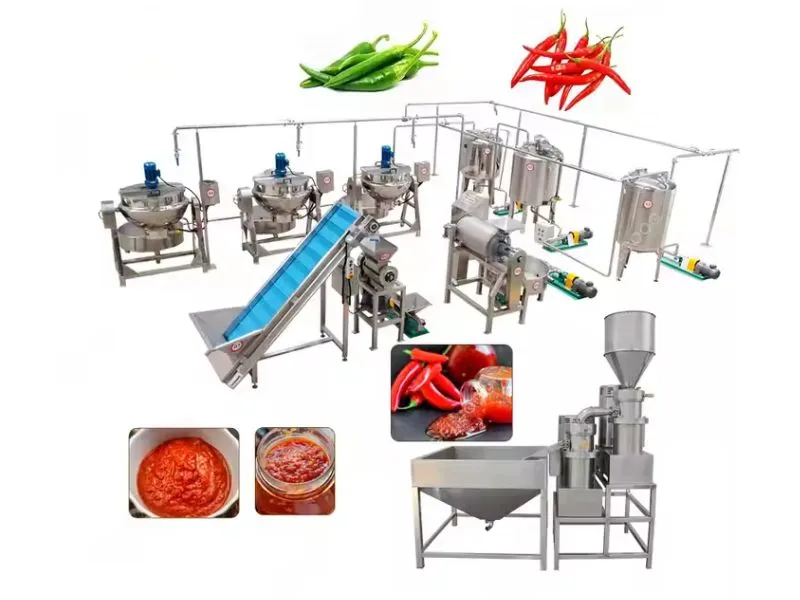
- Chili stem cutting machine
This equipment is mainly used to remove the stems of fresh chili and dried chili. The machine has a high cutting rate, minimizes the loss of chili and achieves outstanding working efficiency. It can adapt to various types and shapes of chili, which is an important equipment in the process of processing large quantities of chili. The machine helps to replace a large number of manual labor and greatly improves working efficiency. Not only does it increase productivity, it also removes the crooked parts of chili, solving the current difficult problem of chili processing in the agricultural market.
Main working principle: During the rotating drum process, the outer blade and the wall of the mesh cylinder generate mechanical torque on the chili stem. This force acts through the sieve holes, thereby effectively removing the chili stem.
- Chili Washing and Sorting Machine
The chili washing machine is made of SUS304 stainless steel material, using water as the main medium. Thanks to the powerful turbine fan that creates air bubbles, the chili is stirred and cleaned flexibly. At the same time, the spray pipes and nozzles are arranged on the upper part of the mesh conveyor belt, along with a high-pressure water pump to perform circulating spraying, preventing the chili from floating on the water surface and being thoroughly cleaned.
The chili sorting machine is equipped with a mesh conveyor belt, allowing 5-6 workers to work at the same time to remove poor quality chili.
- Chili dryer
The chili dryer is a specialized equipment for drying chili quickly and effectively in the food processing industry. There are many types of chili dryers, each with its own characteristics and advantages. Here are some common types:
Conveyor Belt Dryer: Uses a conveyor belt to move the chillies through a heated drying chamber. As the chillies move through the chamber, the hot air circulating around them dries the chillies. This method is ideal for drying large quantities of chillies quickly and efficiently.
Heat Pump Dryer: In this type of dryer, the chillies are placed in a chamber where a heat pump creates a hot air flow circulating around them. The trays containing the chillies are stacked on top of each other, and the hot air passes through the trays, drying the chillies evenly.
- Chilli Pulverizer and Separator
The Chilli Pulverizer and Separator consists of two main parts: the crushing device and the pulp separator. The machine operates in the order of crushing and then separating the pulp, which optimizes the speed and efficiency of operation. The machine can automatically complete the crushing, pulp separation and fiber removal steps in one go, greatly reducing the amount of manual work. In addition, the equipment also integrates a self-cleaning function, which is considered one of the high-end machines for large-scale fruit and vegetable processing.
After separating the pulp, the chili pulp with a size of less than 0.6mm, the coarse particles and fibers will be removed. For small production lines, a colloid mill or a wet mill can be used to grind and refine fresh chili. This type of machine has the ability to superfine grind, disperse, emulsify, homogenize and mix effectively. After processing, the chili particle size reaches 2-60μm, the uniformity is over 95%, which is very suitable for superfine processing.
- Chili sauce mixing machine
The chili sauce mixing process takes place in mixing tanks. Powdered ingredients will be dissolved in a powder dissolving tank or a high-cut dissolving tank, then pumped into the mixing tank. Here, chili sauce, water and other additives are mixed evenly at a temperature of 65-80°C. The mixing tanks are made of SUS304 stainless steel, which can be heated by electricity or steam, and are equipped with stirring devices, CIP cleaning balls, temperature sensors, level sensors, and sampling valves.
For small production lines (less than 1 ton/hour), jacketed cooking pots can be used to process chili sauce. Oil, onions, beef kernels and other flavorings will be added to the cooking pot according to the recipe, and then heated by steam, hot water, heat transfer oil, or electromagnetic. During the cooking process, the stirring blades work to mix the ingredients evenly. The stirring method is specially designed to fully contact the pot wall, without creating dead spots, suitable for processing solid ingredients such as chili sauce or hot pot seasoning.
- Chili sauce homogenizer, degassing and sterilization machine
If using a colloid mill to process chili sauce, there is no need for an additional homogenization step. However, if using a separator, it is necessary to use a high-pressure homogenizer to emulsify and smooth the sauce, helping the sauce to reach the ideal smoothness.
There are two methods for sterilizing chili sauce:
- Use a tube sterilizer to heat the chili sauce to 95°C for 15-20 seconds, then pack it immediately into bottles or bags.
- Use a cooking pot to boil the ingredients, then pack. This method is suitable for small capacity lines.
- Chili Sauce filling and packaging machine
The chili sauce filling machine uses a piston-type metering mechanism for hot filling.
- Accurate measurement: The servo control system ensures high accuracy when filling.
- Flexible speed: During the filling process, when the target capacity is close, the machine can reduce the speed to fill slowly, avoiding overflow and pollution.
- Convenient adjustment: To change the filling capacity, just adjust the parameters on the touch screen, all the filling heads will automatically change simultaneously. In addition, the dosage adjustment only needs to be done on the touch screen.
Optimizing the chili sauce production process with modern machinery not only brings economic benefits but also contributes to enhancing the reputation and competitiveness of the enterprise in the market. Advanced equipment such as stem cutters, grinders, dryers, or automatic packaging systems not only ensure product uniformity and safety but also significantly reduce manual work. This is a clear demonstration of sustainable and intelligent development in the food processing industry today.
