


Overview of powdered milk production line
13-08-2025 810
The powdered milk production line helps bring consumers high-quality dairy products, meeting diverse nutritional needs. The powdered milk production process not only ensures safety and hygiene but also optimizes the use of fresh milk, helping to create products suitable for many customer groups.
Mục lục
Vietnam Powdered Milk Market
The milk market in Vietnam is currently witnessing a diversity of milk products, with more than 500 different types of milk from many famous brands, serving many customer groups.
Powdered milk is one of the most popular products, thanks to its convenience and ability to provide nutrition for different groups of people, from the elderly, pregnant women, sick people to children of different ages.
According to a report by the Vietnam Dairy Association, the milk market revenue in the last two years (2022 - 2023) reached VND 125,200 billion and VND 125,882 billion, showing stability in milk consumption. However, it is forecasted that in the coming years, when milk consumption demand recovers after the impact of impact factors, the dairy industry will witness a new growth cycle.
The dairy industry in Vietnam is experiencing fierce competition in terms of production lines and technology between domestic enterprises, including big names such as Vinamilk, TH True Milk, Nutifood, IDP, accounting for about 75% of the market share, and international enterprises such as FrieslandCampina, Nestlé, Abbott, Mead Johnson, Fonterra, with the remaining market share. This is a sign of the development and potential of the dairy industry in the Vietnamese market.

Main machinery in the powdered milk production line
In the powdered milk production line, the main machinery plays an important role in each stage to ensure the quality and standards of the final product. Below is a description of the main equipment:
- Milk receiving and storage unit
As in a milk powder processing plant, a large amount of raw milk will be required, so raw milk receiving, quality control and storage are necessary to ensure efficient, hygienic and safe milk handling from the delivery point to the storage area before further processing. Here is an overview of the process and the main components:
Receiving and unloading fresh milk: fresh milk is transported by truck to the milk processing plant, during the transportation, the milk must maintain a low temperature to prevent bacteria from growing rapidly. Then, the fresh milk will be pumped into the milk receiving tanks using a flow meter on the milk pipeline and a double pipeline filter can be installed to remove all impurities in the milk during the transportation process.
Fresh milk quality inspection: Take fresh milk samples to check the color, temperature, fat content, protein content, bacteria count, antibiotics and other impurities before storing in the milk tank.
Cooling and preserving fresh milk: After checking the milk quality, the qualified fresh milk will be cooled to 4℃ and pumped into the milk tank for further processing. During the storage process, the milk must be kept at a temperature of 4 degrees, to do this, the milk tank must be insulated and ice water can be supplied to the shell to cool the milk.
- Centrifuge
The centrifuge is used to separate or standardize the fat content in milk. This equipment helps to classify milk into whole milk or skim milk, according to production requirements. Thanks to the ability to accurately adjust the fat ratio, the centrifuge ensures that the product meets nutritional standards.
- Pasteurization equipment
The pasteurization equipment performs a heat treatment process to eliminate harmful microorganisms in milk. The HTST (high temperature, short time) method is used to maintain the nutritional value, while ensuring the microbiological safety of milk before moving to the next stages.
- Vacuum evaporator
Concentration is to use heat to evaporate part of the water in milk and continuously remove it, thereby increasing the solids content in milk. Pre-treated milk uses a falling film evaporator to concentrate to a solids content of 45%-55%, so that the condensed milk is 1/4 of the original milk volume, and the temperature of the condensed milk is usually around 47-50 ° C.
Evaporation concentration is an indispensable process for the production of high-quality milk powder. If not pre-concentrated, the milk powder particles will be very small and contain a lot of air, and the shelf life will be shortened.
Milk evaporation process uses a multi-effect multi-process falling film evaporator. Milk is distributed into the membrane tube twice or more in the evaporator so that the membrane is divided into two or more times in the same evaporation area, which increases the flow and thickens the material film, is not easy to deposit and the cup tube, bacteria are not easy to breed, the running time is long, reducing the number of cleaning times and cleaning costs.
- Homogenizer
The homogenizer is responsible for evenly dispersing the fat particles in the milk, reducing the size of the fat particles so that the final product has a smooth and stable texture. This not only improves the solubility of milk powder but also improves the overall quality of the product.
- Milk Spray Dryer
The spray drying process is divided into two stages. In the first stage, the condensed milk is pumped into the drying tower for spray drying. In the drying room, under the protection of the annular air curtain, the hot air is quickly mixed into the spray droplets through the dispersed hot air distributor, so that the droplets are instantly evaporated in 0.4 seconds. The pressure of the hot air makes the dry powder quickly blown into the integrated vulcanization layer at the bottom. The temperature of the milk powder does not exceed 75°C.
The second stage is fluidized bed drying, the function of the fluidized bed dryer is to remove excess moisture and cool the milk powder, and then dry it into milk powder with a water content of 2%-3%.
The fine powder obtained from the powder collecting section can also be re-polymerized and granulated through the integrated fluidized layer at the top or bottom of the tower, thereby improving the instantaneous solubility of the product.
- Heat exchange system
This system is used to heat and cool milk at different stages, such as pasteurization or before drying. Precise temperature control helps maintain the quality of milk and prevent unwanted changes.
- Automatic packaging machine
After drying, milk powder is packaged by an automatic packaging machine. This equipment ensures that the product is sealed, preventing the penetration of air, moisture and bacteria. This helps to preserve the nutritional value and prolong the shelf life of milk powder.
- Tanks and pumping system
Liquid milk during the processing stages is stored in tanks and transported through a pumping system. The tanks and pumping systems are made of stainless steel to ensure hygiene and prevent contamination, meeting food safety standards.
These devices work together in harmony, creating a closed, modern and efficient production process, meeting the increasing demand for quality milk powder in the market.
- CIP system for milk powder factory
CIP system is an automatic device that provides cleaning, washing, sterilization, on-site without disassembling equipment in the production line. They connect pipes, pumps, tanks and other transport and production components together to form a circuit.
Then pump a series of cleaning solutions and flush through the circuit at different temperatures, the purpose is to soak, separate and clean any debris, dirt or residue left in the equipment and pipes to ensure the entire whole milk powder production line is clean and hygienic.
CIP cleaning frequency is very important for the production of high quality milk powder. Tanks, pipes and pasteurizers will be cleaned daily/shift to ensure that the product contact surface is always clean. For milk evaporators and milk powder spray dryers, CIP cleaning should be done thoroughly once a week.
The milk powder production line is a key factor in creating milk powder products with superior quality, meeting the nutritional needs of consumers. Each stage in the production process is strictly controlled to ensure consistency and safety for the health of users. When choosing milk powder products, consumers should pay attention to the production process to ensure receiving standard and best products for health.
Products from the powdered milk production line
Modern powdered milk production lines play an important role in providing essential nutritional products to consumers. Products from this process are not only diverse but also meet the different nutritional needs of all ages.
- Whole milk powder
One of the most popular products, processed from raw milk. The production process includes adding food additives and nutritional enhancers, then concentrating and drying to form a powder.
Whole milk powder is usually packaged in composite bags or tins, helping to preserve it for a long time while still maintaining good quality. The standardization process in the production of whole milk powder is very important to ensure consistent quality for each batch of products.
- Skimmed milk powder
The most commonly produced product in the powdered milk industry. Made from fresh milk, through a centrifugal separation process to remove fat, then concentrated and dried, skimmed milk powder retains most of the beneficial nutrients from milk, but reduces the amount of fat. This is the ideal choice for those who want to supplement nutrition without worrying about the amount of fat.
- Sweetened whole milk powder
A combination of whole milk and white sugar, processed in the same process as whole milk powder, but with added sweetness from sugar. After adding food additives, the milk is concentrated and dried to form a powder. This product is suitable for those who prefer a mild sweetness in drinks or food processing.
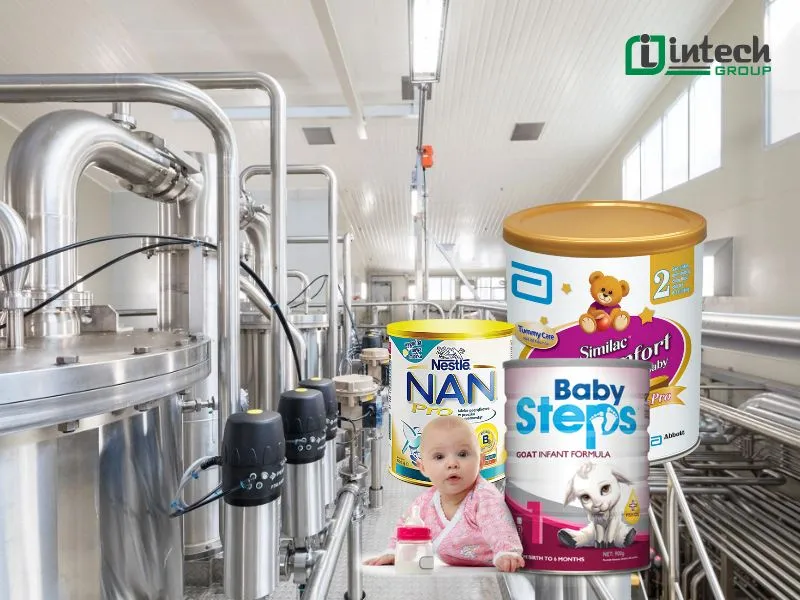
- Infant formula powder
Specially produced to meet the nutritional needs of children under 12 months of age. The production process of infant formula powder uses fresh animal milk, combined with vitamins, minerals and fats necessary for the development of children.
Non-heat-sensitive ingredients such as fat are wet-blended and pasteurized, then the milk is concentrated and dried. Finally, heat-sensitive ingredients such as vitamins and minerals are dry-blended and carefully packaged.
- Flavored milk powder
Milk powder products can be made from many different flavors, such as vanilla, chocolate or strawberry, depending on consumer preferences. This production process also uses milk as the main ingredient, combined with auxiliary ingredients such as flavorings and colorants, then concentrated and dried to create powdered milk products with attractive flavors.
Powdered milk products from the production line not only bring convenience in use but also provide a variety of choices, meeting the nutritional needs of consumers of all ages.
Conclusion
The powdered milk production line is a key factor in creating powdered milk products with superior quality, meeting the nutritional needs of consumers. Each stage in the production process is strictly controlled to ensure consistency and safety for the health of users.
When choosing powdered milk products, consumers should pay attention to the production process to ensure receiving products that meet standards and are best for health.
