


Overview of the electronics manufacturing process
18-08-2025 608
The electronics manufacturing industry is booming significantly due to increased demand from emerging market countries. As a result, the output of electronics manufacturing processes is increasing in many countries and investment in this sector has skyrocketed.
Mục lục
The electronics manufacturing industry is booming significantly due to the increased demand from emerging market countries. As a result, the output of the electronics manufacturing process is increasing in many countries and investment in this sector has skyrocketed.
There are several components required for the production of electronic products, regardless of the size of the manufacturer. However, the process of creating electronic circuit boards involves several distinct stages.
Electronic assemblies are now more necessary than ever, so these products need to be produced continuously. This takes us deeper into the electronics manufacturing process, manufacturing processes, challenges, and more.
There are several components required for the production of electronic products, regardless of the size of the manufacturer. However, the process of creating electronic circuit boards involves several distinct stages.
Electronic assemblies are now more necessary than ever, so these products need to be produced continuously. This takes us deeper into the electronics manufacturing process, manufacturing processes, challenges, and more.
What is the electronics manufacturing process?
The electronics industry produces consumer electronics, electrical components, and industrial electronics. It includes a series of steps in the manufacturing process. Among the electrical devices commonly created by the electronics manufacturing industry are circuit boards, televisions, and portable electronic devices.
The electronics manufacturing industry includes industrial electronics, networking, electronic components, telecommunications, and consumer electronics.
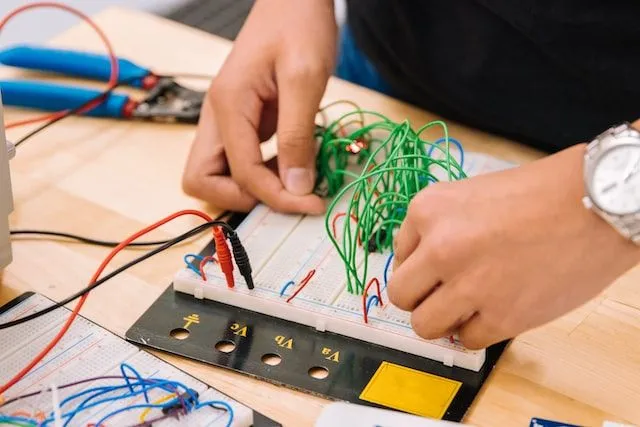
Electronics Manufacturing Process steps: From Idea to product
The main processes used in electronics manufacturing today include printed circuit board or PCB design and assembly, cable assembly, packaging, prototyping, and testing. We will take a closer look at the technologies that support each of these processes.
- Design
The electronics manufacturing process begins with the design phase. Here, engineers create a manufacturing blueprint for the device. They must consider the components needed, the intended use of the device, and the assembly process.
After creating a design, they build prototypes and test them to ensure they function as expected.
- Prototype
Once the design is complete, the process moves to creating the electronics manufacturing product. The electronics manufacturing company will begin the project and complete it on schedule after recording all the specific features for the electronic manufacturing goods.
Considerable research and brainstorming is usually conducted before the actual manufacturing process begins. This helps to minimize risk and avoid wasting time and money.
The final product should be an exact replica of the design in every detail and specification.
+ Purpose of Prototyping:
Prototyping serves many purposes, including testing the product design, verifying the product's functionality, and gathering customer feedback.
It also provides an opportunity to identify and resolve any technical issues with the product, such as manufacturing difficulties or component compatibility issues. Prototyping helps ensure that the final product meets the desired specifications and requirements.
+ Types of Prototyping:
There are several types of prototyping, including physical prototyping, virtual prototyping, and rapid prototyping. Physical prototyping involves creating a physical model of a product using materials such as plastic, metal, or wood.
Virtual prototyping involves creating a computer-generated simulation of a product. Rapid prototyping involves using advanced technologies, such as 3D printing, to quickly create a physical model of a product.
+ Prototyping Process:
The prototyping process typically involves several stages, including design, development, and testing. During the design stage, the product is conceptualized and a design plan is created. During the development stage, a prototype is produced based on the design plan.
The final stage, testing, involves evaluating the functionality and performance of the prototype to identify any issues that need to be addressed before mass production begins.
+ Importance of Prototyping:
Prototyping is important for a number of reasons, including reducing the risk of manufacturing defects, improving the overall quality of the product, and shortening time to market.
Prototyping helps identify any design or functional issues with the product, which can be corrected before mass production begins. It also provides an opportunity to gain customer feedback, which can be used to further improve the product.
- PCB Assembly
Surface Mount Technology (SMT) board assembly involves a number of different techniques (pick and place).
Using a solder pad, the printed circuit board is initially soldered. The component pads are typically coated with a layer of solder paste. Flux and small solder particles are the only ingredients in the solder paste.
After the solder paste is added, the board is passed through a pick and place machine, which picks up components from the dispenser and places them in the correct position on the board.
Then, soldering is used to ensure that the components are perfectly bonded. The assembled PCB, like the manufactured PCB, will undergo many tests and inspections before being sold.
- Electronic Packaging
Now comes the packaging part. The steps are simple:
- Choose materials based on the environment and exposure to the elements,
- Build the enclosure,
- Protect the PCB inside,
- Connect all cables to the connectors on the surface of the enclosure and seal the inside of the enclosure from the outside (if necessary) with protective film, coating, or foam.
It is important to ensure that the equipment container is code compliant. Although it may seem like a small step, it is essential. Because the finished equipment must be able to handle specific stresses and loads.
To name a few, the packaging options include metal, ceramic, and glass-sealed enclosures, sheet metal or alloys, castings or machined parts, molded, extruded, or injected plastics, and plastic or synthetic coatings.
Enclosing a device requires testing to various requirements to ensure reliability and warranty coverage. It is common knowledge that IP certification provides a certain level of protection against solid and liquid particles; the first digit represents solid particle protection and the second digit represents liquid particle protection. In addition, there are additional and optional letters that have very specific use cases.
- Testing
Every assembled PCB must undergo visual inspection. Using an X-ray machine, short circuits, interruptions, and soldering errors are often detected. The PCB must then pass a functional test before it is ready for use.
Once mass production of electronic manufacturing equipment has begun, testing, also known as quality control in production or quality assurance, is necessary to ensure the quality of the items. Any gadget will have a sticker listing the test requirements it meets as proof that it has done so.
Testing is generally divided into four categories: physical, electrical, analog, and/or digital testing. To determine whether a board can withstand a certain amount of heat, it is put through physical testing (checking whether the board functions as expected, logically).
The device being tested is called a DUT (Device Under Test), EUT (Equipment Under Test) or UUT in the industry.
If the board is a prototype, the manufacturer may choose to send it to a large-scale manufacturing facility or to an assembly line, where the board is assembled with the necessary cables, connectors and enclosures and delivered to the customer after passing all the tests.
- Packaging and shipping
After testing, the products are packaged and shipped to retailers. Finally, they are sold to customers.
+ Packaging Design and Selection:
The first step in the packaging and shipping process is the design and selection of packaging materials. The packaging design must protect the electronic products from physical damage, moisture and other environmental factors during transportation.
The packaging materials must also meet industry standards for durability, strength and recyclability.
+ Packing Preparation:
After selecting the packaging material, the next step is to prepare the product for shipping. Electronic products are carefully packaged, ensuring that there is enough padding and protection to avoid damage during shipping.
The packaging must also be labeled and filled with all necessary information such as product name, weight, and destination.
+ Inspection and Testing:
Before shipping, packaged electronic products are inspected and tested to ensure that they meet the required quality standards.
The inspection process will check for any physical damage, defects, or other issues that may affect the performance of the product. If any issues are found, they will be resolved before shipping.
+ Shipping and Logistics:
The final stage in the packaging and shipping process is the shipping of electronic products. The products are carefully loaded onto trucks, trains, or ships and transported to their destination.
The logistics of the shipment are managed by logistics professionals who coordinate transportation, customs clearance, and delivery.
+ Delivery and tracking:
Once the products reach their destination, they are delivered to the customer or warehouse. The delivery process includes unloading and dismantling the products, and checking for any damage or problems.
The tracking process involves monitoring the delivery, resolving any issues that may arise, and ensuring that the customer is satisfied with the delivery.
Challenges faced in the electronics manufacturing process
Consumer electronics manufacturing is one of the most competitive and dynamic industries in the world. Businesses must constantly innovate and adapt to the ever-changing environment to succeed.
However, the industry also faces a number of challenges. Below we have listed the challenges in the electronics manufacturing process:
- Shorter product lifecycles
Another issue that electronics manufacturing has to deal with is the short product lifecycle. Because of the rapid change, products have to be replaced with newer models. High levels of e-waste and scrap can be a result of this.
- Rapidly advancing technology
One of the biggest issues facing the electronics manufacturing industry is the rapid pace of development. The pace of technological development is constant.
Businesses must constantly update their products to stay competitive and prevent perishable inventory, including food or cosmetics, from being locked up in their warehouses. Furthermore, both money and time can be spent on this process.
- Pressure to increase prices
Due to fierce competition, the consumer electronics industry is under a lot of pressure to set selling prices. Profit margins of businesses are affected by the need to constantly reduce costs.
- Raw Material Availability
Many consumer goods are made with rare earth metals and other difficult materials. This can lead to shortages and increased costs. For example, the catastrophic global chip shortage that began in 2020 has hurt many companies, including Toyota and Sony.
- Changes to Consumer Preferences
Businesses are having a hard time meeting demand because consumer preferences are constantly changing. For example, the rise of smartphones has reduced the demand for traditional phones and other devices.
- Environmental Factors
Like many other economic sectors, the electronics manufacturing industry is currently experiencing a significant boost. Consumers and regulatory bodies are prioritizing issues related to global warming and climate change. New laws and regulations are being created every day.
Global warming and climate change have quite different meanings even though they are sometimes used interchangeably. Climate change can affect the long-term average temperature of our atmosphere and oceans. “Global warming” simply refers to an increase in temperature (not a decrease).
Because it is one of the most common and important materials used in the manufacture of electronics, manufacturers today take reducing their carbon footprint very seriously.

- Economic Situation
Consumer electronics manufacturing is susceptible to changes in the economy. For example, the global recession of 2008–2009 had a significant impact on consumer electronics sales.
- Intellectual Property Theft
In the consumer electronics industry, intellectual property theft is a problem, especially when outsourcing. It often occurs with products that are copied and sold as counterfeits. Businesses can lose sales and revenue as a result.
- Supply Chain Constraints
Electronics manufacturing relies on complex global supply chains. It can be more vulnerable to disasters such as natural disasters or political instability. All of these will have a major impact on your production time.
- Data Security Risks
Data security vulnerabilities are getting worse as more products become connected. Hackers could gain access to customer data or trade secrets, which could have catastrophic consequences.
- Emerging Markets
Developing countries are receiving more attention from the consumer electronics industry. These markets can be difficult to penetrate due to diverse languages, cultures, and business practices.
- End of Life Management
Products that have reached their end of life must be properly disposed of. This helps prevent environmental pollution. For the consumer electronics industry, this can be a challenge because so much is thrown away every year.
- Sustainability
There is pressure to make electronics manufacturing less harmful to the environment. For example, there is a growing market for products made from recycled materials.
- Warranties and Support
Customers often demand extended warranties and support for their purchases. For electronics manufacturers, this can be costly, especially if a product fails soon after purchase.
- Environmental Laws and Regulations
Some environmental rules and regulations apply to the manufacturing of electronics. However, these restrictions can affect the manufacture, use, and design of goods.
Future trends in electronics manufacturing
The ability for engineers and hobbyists to produce their own concepts in the same mass production facilities is starting to become important. In this case, it is called “Made to Order”. And as decentralization and individual invention come back into fashion, it is considered one of the likely trends.
The development and improvement of assembly lines that produce better and more cost-effective electronic components is another wave that is currently underway. It is being further supported by electronics manufacturers. These growing industries include aerospace and space tourism.
The development of technology using artificial intelligence and machine learning is the final, important topic. These gadgets have the power to change civilization as we know it forever.
- Using Eco-Friendly Materials:
One of the biggest trends in electronics manufacturing today is the use of eco-friendly materials. This trend is driven by concerns about the environmental impact of electronic products, as well as the desire to reduce costs.
Companies are looking to use more sustainable materials, such as recycled materials and bioplastics. Additionally, they are working to reduce waste by designing products that are easier to recycle and reuse.
- Applying Lean Manufacturing Techniques:
Another important trend in electronics manufacturing is the application of lean manufacturing techniques. Lean manufacturing is a philosophy that focuses on reducing waste and improving efficiency.
Companies are using lean techniques to streamline manufacturing processes, reduce costs, and improve product quality. This includes using tools such as just-in-time inventory management, continuous improvement, and value stream mapping.
- Focus on supply chain management:
The third trend in electronics manufacturing is a focus on supply chain management. With the rise of globalization, companies face the challenge of managing complex global supply chains.
To be successful, they must have a deep understanding of their suppliers, customers, and the markets they serve. They are also using technology to improve supply chain visibility and efficiency, such as using big data and analytics to optimize their operations.
- The emergence of smart manufacturing:
The fourth trend in electronics manufacturing is the emergence of smart manufacturing. Smart manufacturing refers to the use of advanced technologies, such as the Internet of Things (IoT) and artificial intelligence (AI), to improve manufacturing processes.
Companies are using these technologies to collect and analyze data from their manufacturing operations to make better decisions and improve their processes. For example, they can use sensors and predictive analytics to predict equipment failures and reduce downtime.
- The Rise of Automation:
The fifth trend in electronics manufacturing is the rise of automation. Automation is the use of technology to automate manual processes, such as assembly and testing.
Companies are using automation to improve efficiency, reduce costs, and improve product quality. Automation also allows companies to produce products faster, reducing time to market for new products.
Automated Conveyor systems: A driving force in electronics manufacturing efficiency
Automated conveyor systems have become an indispensable tool in modern electronics manufacturing plants. With the ability to automate production stages, the electronic production conveyor system has brought about positive changes, significantly improving efficiency and product quality.
Why are automated conveyors important in electronics manufacturing?
- Conveyors move components and products continuously between stages, minimizing downtime and increasing production speed.
- Arrange stages in a reasonable way, creating a smooth and efficient production flow.
- Automated machines have higher precision than manual operations, ensuring products are assembled accurately.
- Integrate sensors and automatic inspection equipment to detect and eliminate defective products at the beginning.
- Automating stages helps to minimize errors caused by human factors such as errors during the assembly process.
- Easily adjusted to suit different types of products and production processes.
- Can be combined with new technologies such as artificial intelligence, robots to improve efficiency.
- Automation helps reduce the number of workers needed.
- Higher quality products, fewer errors, longer life and lower warranty costs.
- Minimizing human intervention in dangerous stages helps reduce the risk of work accidents.

Conclusion
Electronics manufacturing is a complex and challenging process that requires careful planning and execution. From design and prototyping to assembly and testing, each stage of the manufacturing process must be carefully managed to ensure the quality of the final product. Companies must also ensure that their manufacturing processes are efficient, cost-effective, and environmentally sustainable.
To be successful in electronics manufacturing, companies must follow best practices such as defining their manufacturing processes, using lean manufacturing techniques, focusing on quality control, streamlining their supply chains, investing in automation, and using data and analytics. They must also foster a culture of continuous improvement, always looking for ways to improve their processes and products.
The industry is also facing new challenges as technology continues to advance, such as the rise of the IoT and the growing demand for environmentally friendly products. Companies must stay ahead of these trends by continually improving their processes and investing in new technology.
