


Palletizing Robot System for Automatic Loading and Unloading of Goods
20-08-2025 403
The Automated Palletizing Robot System is an effective solution that allows you to efficiently stack mixed box pallets containing different product sizes. The system is capable of serving multiple lines, flexible operation and compact.
Mục lục
If you have a medium to high volume packaging process, palletizing is probably an integral part of that process. There are a number of options for automated palletizing. However, robots are quickly becoming an extremely popular option due to their versatility and ability to handle mixed pallets.
What is a Robotic Palletizing System?
A Robotic Palletizing System uses a robotic arm to pick, orient, and place individual products and stack them onto pallets safely and efficiently. The robot typically stands between the pallet dispenser and the pallet conveyor that delivers the products. A hydraulic robot arm lifts the products and neatly stacks them onto pallets.
Automated Palletizing Systems are a key part of industrial palletizing automation that has revolutionized the way businesses handle goods. From the food and beverage industry to pharmaceuticals and manufacturing, Robot Palletizing is now an essential part of modern production lines. These machines bring consistency, speed and reliability to the process, replacing the monotony of manual labor with the precision of advanced robotics.
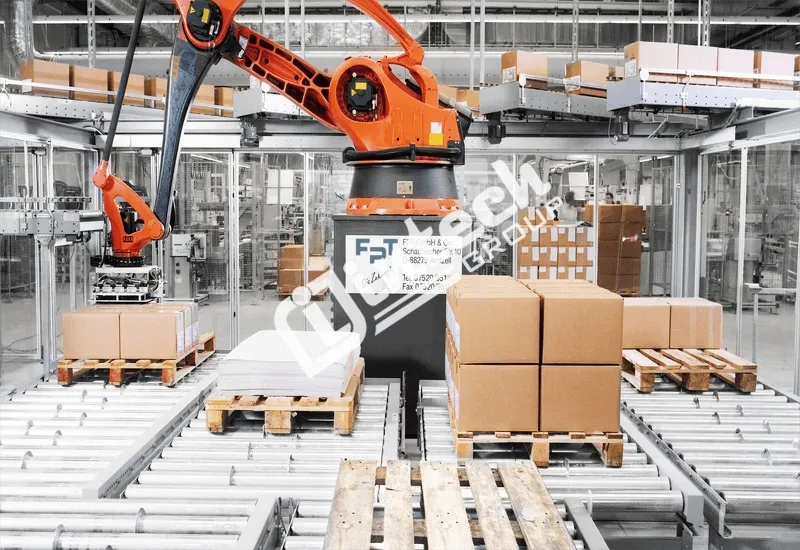
How it works Robot Palletizing systems for automated palletizing
A Robotic Palletizing System uses an arm equipped with an end effector, called an End-of-Arm Tool, to pick items from a conveyor or other type of feeder. The selected items are then precisely placed onto the pallet by the robot in a pre-programmed pattern. This process is repeated until a full layer of product is created and then the next layer begins.
This advancement of fully automated Robot Palletizing systems offers high uptime, fast ROI and operational flexibility. Fully automate the palletizing process without the need for additional equipment.
For beverage manufacturing, integrating a robotic palletizing system with an automated case handling system will increase the throughput of mixed case palletizing to 2,500-4,000 cases per hour.
Steps of operation of an Automated Palletizing Robot:
- The process begins with items being loaded onto a conveyor or production line
- A series of sensors and field devices detect incoming items.
- The robotic arm, equipped with a specially designed end effector, picks up the item.
- The item is then placed onto the pallet in the most efficient pattern.
- This process is repeated until a layer is completed.
- Once a layer is complete, the next layer begins, stacking precisely on top of the previous layer.
- This continues until the pallet is fully loaded, ready for shipping or storage.
Benefits of Using Automated Palletizing Robot Systems
Automated palletizing robots offer many benefits and are often an effective way to mitigate key efficiency challenges in the supply chain.
- Modular Design:
Automated palletizing robots are much more modular than traditional forms of automated palletizing. They can also be easily switched between programming for different products and pallet layouts, providing flexibility on demand.
- Increased Efficiency and Throughput
Palletizing robots work faster and more accurately than humans, significantly increasing overall productivity. The accuracy and speed of automated systems allow for handling a wide range of products at speeds that manual labor cannot match. This results in higher throughput, less downtime, and increased profits. Whether handling homogeneous products or mixed pallet loads, robotic palletizing systems adapt seamlessly, ensuring consistent quality and performance. In turn, the ability to meet production goals and customer demands becomes more consistent and reliable.
- Reduced Labor Costs
Automation reduces the need for manual labor, resulting in significant cost savings in the long run. By automating the palletizing process, factories can reallocate human resources to higher value-added tasks where critical thinking and problem solving are essential. This not only reduces the direct labor costs associated with palletizing, but also minimizes the costs associated with training, supervision, and potential injuries. The result is a more streamlined operation that leverages technology to achieve cost efficiencies without compromising quality.
- Seamless integration:
Integrating robotic palletizing systems into existing spaces and into existing production processes is relatively easy because they are self-contained units.
- Improved safety
By handling heavy loads and repetitive tasks, robotic palletizing systems reduce the risk of workplace injuries, creating a safer environment for your workforce. By delegating these tasks to robotic systems, workers are less likely to be exposed to these risks. Furthermore, modern palletizing systems are equipped with advanced safety features that ensure they operate within defined parameters, further enhancing the overall safety of the plant.

Comparing Conventional Palletizing Systems and Robotic Palletizing
While conventional palletizing systems are an older form of technology, newer robotic palletizing systems are not a complete replacement. Each has its own advantages that are suitable for specific applications.
- Low cost for simple applications
For simple palletizing solutions, robotic arms can be used when speed is not a critical factor. Using a robotic arm eliminates the need for multiple conveying systems, rotating mechanisms, stoppers, gates, etc. Therefore, a robotic arm is a cheaper option provided it can handle the required capacity.
- Speed
Increasing speed and reliability have always been the goals in palletizing technology. As palletizing systems become better equipped to handle a wider range of tasks, both conventional and robotic palletizing systems are now capable of handling most load requirements.
Conventional palletizing systems typically have a speed advantage over robotic palletizing systems. While robotic palletizing systems excel at precise and flexible movements, conventional palletizers excel at performing multiple palletizing operations quickly.
- Pattern Complexity
While robotic palletizing systems are capable of stacking individual units in a variety of ways, they can present limitations when handling variations between cases. For example, if complex patterns are required for multiple cases, the packaging process will need to account for these variations in some way.
- Product Type
Bags, boxes, and other shapes pose specific challenges for different palletizing systems. Conventional palletizing systems work best with packages that are consistent in shape and size, allowing them to operate at maximum speed and efficiency. In contrast, robotic palletizing systems can handle almost any type of package carefully and individually.
Applications of Robotic Palletizing Systems
Automated palletizing is rapidly becoming the norm in many different industries. It offers significant advantages in terms of efficiency, accuracy and cost savings. Here are some of the key areas where Robotic Palletizing is making a difference.
- Food and Beverage Processing
Automated palletizing robots in the food and beverage industry have revolutionized packaging and distribution. They ensure consistent stacking and reduce product damage, resulting in higher product quality. The speed and accuracy of robotic palletizing is critical in handling perishable items, minimizing waste and maximizing shelf life. This efficiency translates into lower operating costs and increased profits.
- Pharmaceutical Industry
In the pharmaceutical industry, automated palletizing robots offer unprecedented precision and control. They are instrumental in handling sensitive products that require careful handling and specific layout. Automation ensures compliance with strict regulations and enhances traceability. The result is improved safety, reduced risk of contamination and higher overall quality standards.
- Manufacturing and Automotive
The manufacturing and automotive industries have long been pioneers in automation and palletizing is no exception. Robotic Palletizing systems automatically handle a wide range of components and products, from small parts to large assemblies. They improve productivity, reduce labor costs and minimize the risk of injury. The flexibility of robotic palletizing allows for rapid adaptation to different packaging and product requirements, providing a competitive advantage.
- E-commerce and Retail
The boom in e-commerce has increased the need for efficient warehousing and distribution. Automated palletizing systems in e-commerce and retail meet the need for speed, accuracy, and scalability. They enable rapid processing of large volumes of orders, allowing businesses to meet customer expectations for fast delivery. By reducing manual labor and errors, automated palletizing contributes to smoother operations and higher customer satisfaction.
- Building Materials Industry
Handling heavy and bulky building materials requires strength and precision. Automated palletizing systems meet these needs by efficiently stacking and sorting products such as bricks, blocks, and cement bags. This automation reduces physical strain on workers, increases productivity, and ensures consistent stacking, resulting in safer transportation and storage.
How much does it cost to invest in a robotic palletizing system?
Robotic Palletizing systems play a vital role in automating the stacking and stacking of products on pallets. However, investing in a palletizing system requires careful consideration of the costs involved. The price of the system can vary greatly depending on the type, functionality, brand, and level of customization.
On average, a basic palletizing system can start from 1 billion VND, while advanced robotic palletizing systems can exceed 3 billion VND. Costs are also affected by the complexity of the system, installation, training, and ongoing maintenance.
Intech Group provides effective robotic palletizing solutions
Automation continues to shape our industries, and robotic palletizing automation is a perfect example. By using robotic palletizing systems, businesses can reduce labor and operating costs, increase productivity and worker safety, minimize downtime and deliver high-quality products, while staying ahead of the Industry 4.0 transformation.
Intech Group's experts will help you choose a high-quality automated palletizing robot that will bring you profits. We will train your employees on how to operate the robot and the software. We will make recommendations on how to achieve a worthy investment in your automated palletizing robot solution in the shortest possible time.
Contact our experts for specific advice, Hotline: 0966 966 032

Video Automatic palletizing robot system | Palletizing System
