


Pharmaceutical Production Line: Pharmaceutical Industry Automation
13-08-2025 735
The pharmaceutical production line plays a key role in determining the quality and effectiveness of pharmaceuticals that reach consumers. An optimized production line not only increases productivity but also ensures compliance with strict safety and quality standards.
Mục lục
With the continuous development of technology, today's pharmaceutical production line is not simply a mechanical system but has become a comprehensive solution, combining automation, efficiency and high precision.
Pharmaceutical production line operation process
The pharmaceutical production process usually includes a combination of specific steps, selected based on the physical and chemical properties of the active pharmaceutical ingredient (API).
- Formulation
Designing the composition of the drug and determining the exact blend of active ingredients and excipients to achieve the desired therapeutic effect.
- Dry granulation
The process of compressing low-density powders to form granules. The roller compression method includes three main systems: screw feeding system, compression system, and grinding system.
- Powder blending
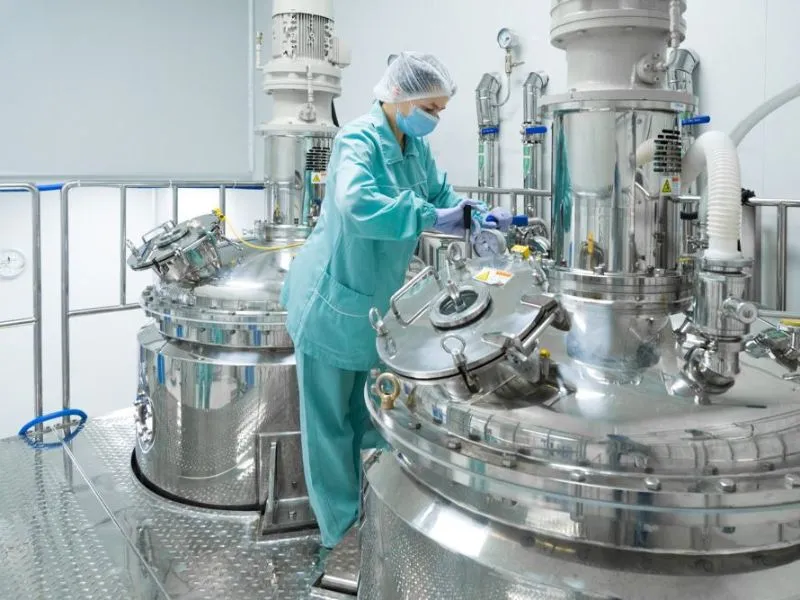
Different types of excipients are blended to create the final mixture used in the production of solid drugs. Since each drug formulation is unique, no two mixing processes are identical.
- Wet and High-Shear Granulation
This process is commonly used to increase density, improve flowability, content uniformity, or wettability, and improve drug delivery quality.
- Fluidized Bed Spray Granulation
This method uses spray techniques such as:
- Top Spray.
- Wurster Spray.
- Tangential Spray.
- This technique is common in both the food and pharmaceutical industries.
- Hot-Melt Extrusion
Used to produce drugs with poor solubility and low bioavailability. This method disperses the active pharmaceutical ingredient (API) into the matrix at the molecular level, forming a stable solid solution.
- Drying
Controlling and understanding the moisture content of powders is important for pharmaceutical production lines. Fluidized bed drying or laminar flow drying methods have a significant impact on the physical and chemical properties of powders or granules.
- Pharmaceutical milling
A process that uses a rotary cutter to remove material from the blank by feeding it at an angle to the axis of the tool.
- Tablet compression of powders or granules
An efficient process for producing drugs in solid tablet form.
- Tablet coating equipment
There are many coating methods, including:
- Batch Coating.
- Continuous coating immediately after tablet compression.
- Continuous Processing.
- Pharmaceutical packaging
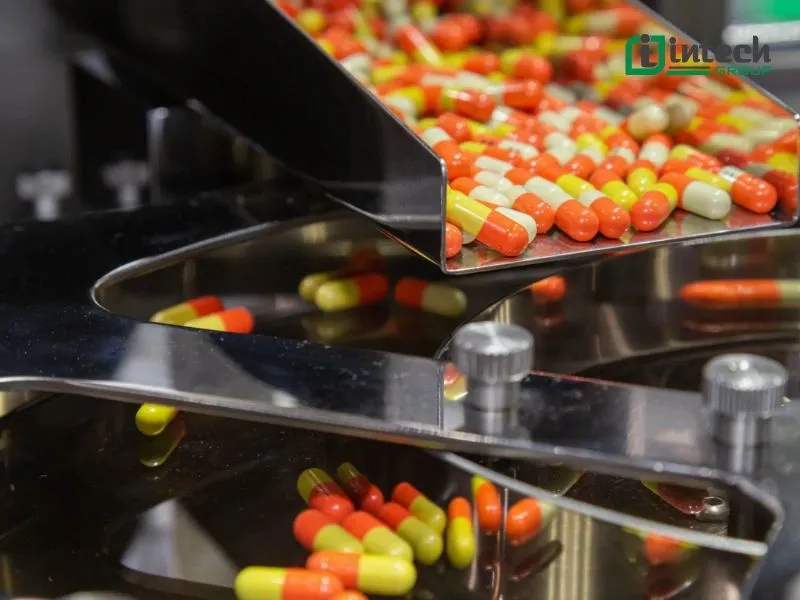
A process of containing a solid or liquid dose of a drug in preformed softgels or hard capsules, ensuring safety and quality.
Machinery in the pharmaceutical production line
The pharmaceutical industry has strict production standards and regulations. Therefore, pharmaceutical production equipment must also comply with industry standards.
To ensure accurate and correct production of the formula, almost every process can be automated. Each stage of the pharmaceutical production line involves an automated production equipment.
1 - Processing machinery
+ Heat exchangers
Used for both cooling and heating, heat exchangers are used to transfer thermal energy from the source to the working fluid. In pharmaceutical production, these heat exchangers are especially important because the chemical reactions to produce drugs and vaccines need to be carried out at a specific temperature. Even during storage, the environment and temperature of the pharmaceutical products must be regulated.
+ Mixer
As the name suggests, a pharmaceutical mixer is used to mix materials – usually in powder or granular form, but sometimes also in liquid form – into a homogeneous mixture.
+ Agitator
A mixer is a type of pharmaceutical mixer used when the materials to be mixed are in liquid form, especially liquids that do not easily mix with each other. Using them promotes chemical reactions as well as heat transfer.
+ Cooling towers
Since temperature regulation is key in the pharmaceutical production line, cooling towers are also an integral part of this process as they help remove unused or excess heat at various stages of the manufacturing or packaging process, such as before packaging, during molding or after heating for sterilization purposes.
+ Pure steam generators
Used to generate pure steam that meets biopharmaceutical standards for use in cleaning, sterilization, freeze-drying and humidification.
+ Centrifuges
Taking things apart is just as important as putting them back together. Industrial centrifuges are effective at separating components of mixtures of different densities – different liquids mixed together or particles mixed with liquids – by taking advantage of centrifugal force. One of the main applications of centrifuges in pharmaceuticals is to achieve reagent purity.
+ Dryers and mills
They are used to remove water or moisture from a substance, creating a final product in solid or dry powder form. Their applications include granulation for making tablets or capsules, extract processing, or reducing the volume of a substance for easy storage and transportation.
+ Inspection Machines
Not all pharmaceutical machines are used directly in the production of drugs or vaccines, but they can be used for related processes. Inspection machines allow for visual inspection of pharmaceutical products and can even be equipped with smart cameras to make the process more efficient.
+ Pharmaceutical Containers
These are basically containers or vessels that can withstand high temperatures and pressures, where chemical reactions, mixing, or other processes related to drug production take place.
+ Other Processing Machines
- Blowers: Used in solvent recovery and other evaporation applications.
- Boiler: Generates steam by applying thermal energy to water.
- Capsule filling equipment: There are various equipment for filling, polishing, and sorting capsules.
- Capsule and tablet printers: To print information such as drug name or dosage on capsules or tablets.
- Chiller: To cool down quickly.
- High pressure homogenizer: The most effective liquid handling equipment for reducing particle size and disrupting cells.
- Metal detector: To detect metal contaminants (pieces of metal such as nuts, screws, or machinery debris) that may contaminate the product.
- Tablet press: Used to produce tablets.
- Tablet dedusting machine: To remove dust generated in the tablet press. Often also polishes tablets.
- Sifter: Used to sift powders or granules.
- Sprayer: Used to spray liquid paint onto powders.
2 - Packaging Equipment
- Blister machines: Designed to pack tablets, capsules, softgels, injectable solutions, syringes, and other small medical items into blister packs. “Blister splitters” are also available to retrieve tablets, capsules, or softgels from blister packs.
- Bottle and Filling Lines: Used to fill liquid bottles or containers for tablets, capsules, or softgels.
- Capping Applicators: Designed to seal filled bottles or containers of medications.
- Cartoning Machines: These sophisticated machines can pack blister packs into small pill boxes, fold and insert leaflets, close, code, and label boxes.
- Counters: Count capsules, tablets, softgels, and any other small, solid items.
- Induction Bottle Sealers: Seal aluminum foil to the mouth of bottles.
- Labeling Equipment: Used to apply or print labels to packaging boxes, bottles, containers, tubes, etc.
- Tube fillers: Used to fill and seal tubes of ointments, creams and gels.
Notes when choosing the right pharmaceutical production line
One of the first factors to consider when choosing the right machinery is the technical requirements of the product. No matter how modern the equipment is, it will be useless if it does not meet the standards and specifications of the desired product. Besides customization, you also need to pay attention to the following factors:
- Quality
Purchasing reliable equipment from reputable manufacturers is a sign of a high-quality pharmaceutical production system. If you choose cheap and cost-cutting solutions, you may end up paying more in poor quality production that wastes valuable resources, incurs high repair costs and results in substandard products.
- Easy to clean
Just buying and installing the equipment is not enough. The pharmaceutical production line needs to be properly maintained and cared for. Therefore, it is extremely important to find designs that are not only efficient in terms of operation but also easy to clean and maintain. Integrated CIP (Cleaning In Place) and SIP (Sterilization In Place) systems will provide maximum support for cleaning.
- Automation capability
In today's era, automation is a key factor to become a leader in the pharmaceutical industry. A smart investment would be to choose equipment with advanced automation capabilities. These machines help reduce dependence on manual labor and ensure product consistency across multiple production cycles.
Conclusion
The pharmaceutical production line is not only the heart of the pharmaceutical industry but also a decisive factor in bringing confidence and peace of mind to consumers. Investing in and developing modern production lines not only helps businesses meet market demand but also contributes to improving public health.
With increasingly outstanding technological advances, the pharmaceutical production line will continue to play an important role in providing safe and effective medical solutions to everyone.
