


Shoe production line details you need to know
11-08-2025 1.005
Shoe production lines play an important role in the strong development of the footwear industry. Innovation in production technology helps to improve productivity, ensure product quality and optimize costs.
Mục lục
From exquisite handmade shoes to mass-produced products using modern technology, each type of line has its own characteristics, meeting the diverse needs of the market.
Steps in the shoe production line
Here are the main steps in the shoe production line
- Design and prototyping
The first step in the shoe production line is design and prototyping. Designers will sketch ideas on paper or use 3D design software to create shoe models that suit market trends.
After the design is completed, a prototype will be created to test the size, style and comfort of the product.
- Prepare materials
Shoe manufacturers choose materials based on the type of shoe and the desired function. Common materials include leather, textiles, rubber, synthetics and foam.
Leather is popular for its durability and comfort. People often use it in dress shoes and casual shoes. They often use fabrics like cotton or wool for lightweight, breathable shoes like sneakers.
Rubber is a popular choice for soles because of its grip and abrasion resistance. Synthetics, like polyester and nylon, are useful because they are versatile and cost-effective in many shoe components. Foam is important for cushioning and comfort, especially in sneakers.
When choosing materials, manufacturers consider a number of criteria. For durability, leather and synthetics are the best options, while for comfort, fabrics and foams are the best. For outdoor shoes, the material should be waterproof and sturdy, such as thick leather or waterproof synthetics. For sneakers, the material should be lightweight and flexible to support movement.
Each material should be appropriate to the design and purpose of the shoe. This ensures that the final product performs well for its intended use, looks good, and lasts as expected.
- Sewing and Assembly
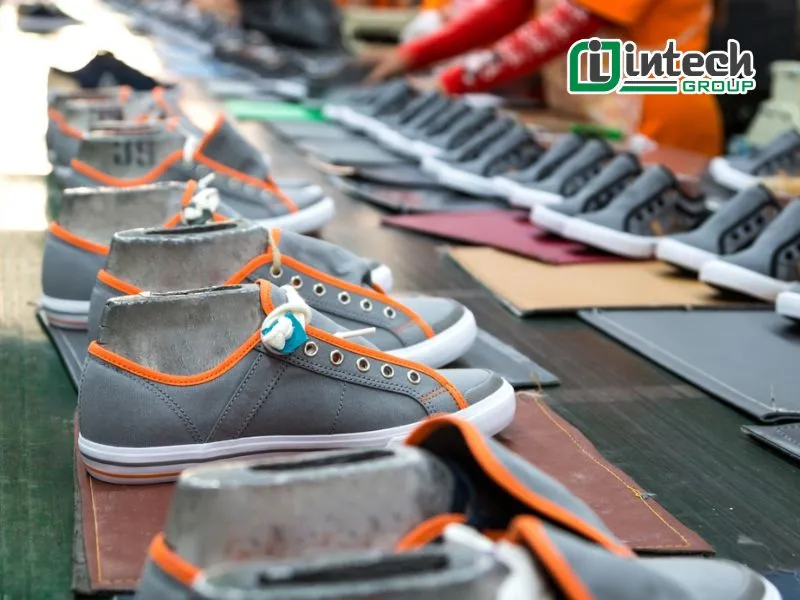
After the shoe parts are cut, they will be transferred to the sewing and assembly stage. Workers or machines will sew, glue and join the parts together. During this process, the shoe sole will be attached to the body with specialized glue or heat pressing technology to ensure firmness.
- Quality control
After completing the assembly process, each pair of shoes will undergo a rigorous quality control process. Evaluation criteria include size, durability, seams, sole grip and overall design. If errors are detected, the product will be adjusted or removed to ensure that only qualified products are released to the market.
- Packaging and shipping
After passing the quality control step, the shoes will be cleaned, labeled and packaged according to standards. The shoe boxes are carefully arranged to protect the products during transportation. Finally, the shoes will be shipped and distributed to stores or customers.
Popular types of shoe production lines
Depending on the scale, type of shoe and level of automation, there are many popular types of shoe production lines. Below are the main types
- Manual shoe production line
Manual shoe production line is a traditional method, requiring meticulousness and high skills of the worker. Each stage from cutting, sewing, assembling to finishing is done by hand or using simple support tools.
The advantages of manual shoe production lines are:
- The product has high sophistication, bearing the worker's own mark.
- The quality and durability of shoes are often superior to industrial production.
- It is easy to create unique shoe models, suitable for the individual requirements of customers.
However, the biggest disadvantage of this method is the long production time and high cost. Therefore, this line is often applied to high-end shoe lines, handmade leather shoes or shoes according to individual requirements.
- Automatic shoe production line
Automatic shoe production lines apply modern technology with the support of machines and robots. Most of the stages such as cutting raw materials, sewing, gluing soles, heat pressing and quality control are automated.
Advantages of automatic shoe production lines include:
- Improving productivity and minimizing production time.
- Ensuring high accuracy, reducing error rates.
- Saving labor costs, thereby reducing product costs.
This type of line is often applied in large-scale shoe factories, specializing in providing shoes for the mass market in large quantities.
- Production lines for sports shoes, leather shoes, fabric shoes...
Depending on the type of shoes to be produced, each line will have differences in the process and technology used:
- Sports shoe production line: Optimized for the production of shoes with rubber or EVA soles, combined with heat pressing technology, sewing with specialized threads to ensure durability and elasticity.
- Leather shoe production line: Using advanced cutting, sewing and leather processing technology, requiring meticulous techniques to create quality products, especially office leather shoes and handmade leather shoes.
- Fabric shoe production line: Usually simpler than sports shoes or leather shoes, focusing on sewing, gluing soles and quality control.
.webp "Shoe production line")
- Conveyor belt in shoe production line
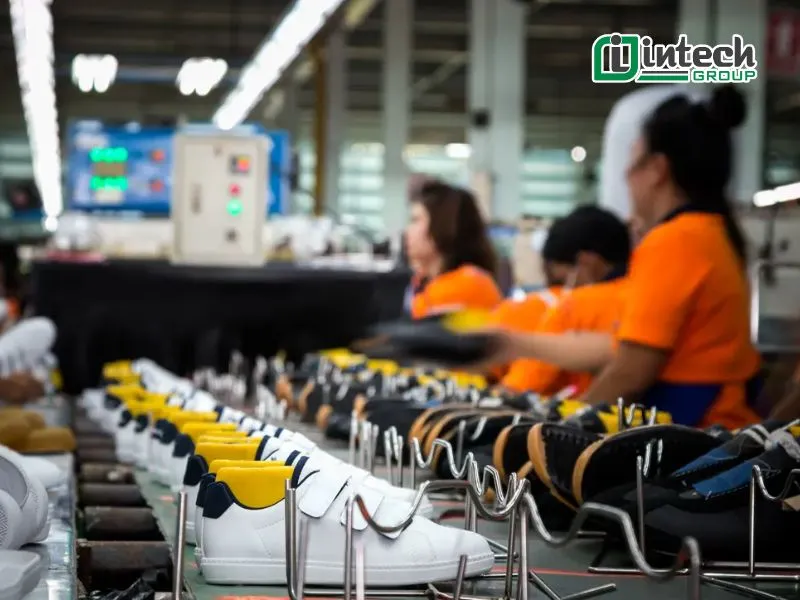
Conveyor belt plays an important role in the shoe production line, helping to optimize the work process and improve production efficiency. The main function of the conveyor belt is to transport raw materials and shoe components (such as shoe soles, shoe body, shoe lining, etc.) from one stage to another continuously and automatically. Thanks to the conveyor belt, workers can work more efficiently, reduce travel time and limit errors due to manual operations.
In addition, the conveyor belt in the shoe factory also helps synchronize the production process, ensuring that each stage takes place smoothly and accurately. Using the conveyor belt in the shoe line not only helps save labor but also reduces material waste, optimizing production costs. In addition, the conveyor belt can be flexibly designed for different types of shoes, from sports shoes, leather shoes to fabric shoes, helping businesses easily adjust according to production needs. Thanks to these benefits, the conveyor belt has become an indispensable part of modern shoe factories.
Benefits of using a shoe production line
Here are the main benefits of using a shoe production line:
- Improve productivity and production efficiency
The shoe production line, especially the automatic line, helps speed up production. Modern machinery and technology can perform many stages at the same time, minimizing waiting time between stages. Thanks to that, businesses can produce large quantities of shoes in a short time, better meeting market demand.
- Ensuring consistent product quality
The use of automatic machinery in the production line helps minimize human errors. From cutting raw materials, sewing, gluing soles to finishing, all are done with high precision. This helps ensure consistent shoe quality, limit defective products and increase brand reputation.
- Saving labor and material costs
Compared to manual production, the use of production lines significantly reduces labor costs. Complex stages can be performed by machines, reducing dependence on worker skills. This not only saves labor costs but also minimizes the risks of production errors due to human factors.
Machine systems in shoe production lines are often programmed to optimize cutting and material usage. As a result, the amount of scrap and excess materials is significantly reduced, helping businesses save costs and contribute to environmental protection.
- Increase competitiveness in the market
Faster production, stable quality and lower costs give businesses a competitive advantage over competitors. Thanks to modern production lines, shoe brands can provide products at reasonable prices while still ensuring quality, attracting customers and expanding market share.
- Flexibility in producing many different designs
Modern production lines can be easily adjusted to produce many different types of shoes such as sports shoes, leather shoes, fabric shoes, office shoes, etc. This helps businesses quickly adapt to market trends and meet the diverse needs of customers.
Shoe production lines not only help businesses increase production efficiency but also bring quality products, meeting modern consumer trends. Choosing and applying the right line will help optimize costs, improve competitiveness and develop sustainably. In the future, with the development of technology, the shoe manufacturing industry promises to have more improvements, bringing better and more environmentally friendly products.
