


Small production line: Advantages and disadvantages classification
15-08-2025 477
Small production lines are becoming the optimal solution for small businesses and households. With outstanding advantages such as low investment costs, easy operation and suitability for many fields, small production lines not only help improve production efficiency but also flexibly meet market needs.
Mục lục
Let's learn about popular types of small production lines and their advantages and disadvantages through the article below.
What is a small production line?
A small production line is a system of equipment and machinery designed to perform a series of production stages automatically or semi-automatically, serving small and medium-sized enterprises or businesses with limited scale.
This system often has the following characteristics:
- Compact size, easy to install and operate in small factory space.
- Low investment cost, suitable for businesses with limited budgets.
- Meet production needs with moderate capacity, ensuring efficiency and product quality.
Small production lines are often applied in many fields such as food, household appliances, packaging, and other light industries, helping to optimize resources and improve production efficiency.

Advantages and disadvantages of installing a small production line
| Criteria | Advantages | Disadvantages |
| Investment cost | Low cost, suitable for small and medium enterprises or business households. | Limited ability to produce on a large scale. |
| Installation space | Compact design, suitable for factories with limited area. | Difficult to expand when businesses want to increase production scale. |
| Operation and maintenance | Easy to install and operate, does not require a highly skilled technical team. | Some types of machinery have a shorter lifespan than large production lines. |
| Production efficiency | Meets the needs of small-scale production or product customization according to customer requirements. | Low capacity, not suitable for businesses that need to mass produce large quantities. |
| Flexibility | Easy to adjust and change according to each specific product type. | Limitations in fully automating complex processes. |
| Financial capacity | Reduces the pressure on initial investment capital, helping businesses focus on other business activities. | When demand increases, new investments may be required, causing additional upgrade costs. |
| Applications | Diverse, applicable to many industries such as food, packaging, plastics, construction materials. | Cannot meet the needs of manufacturing industries that require advanced technology or high output. |
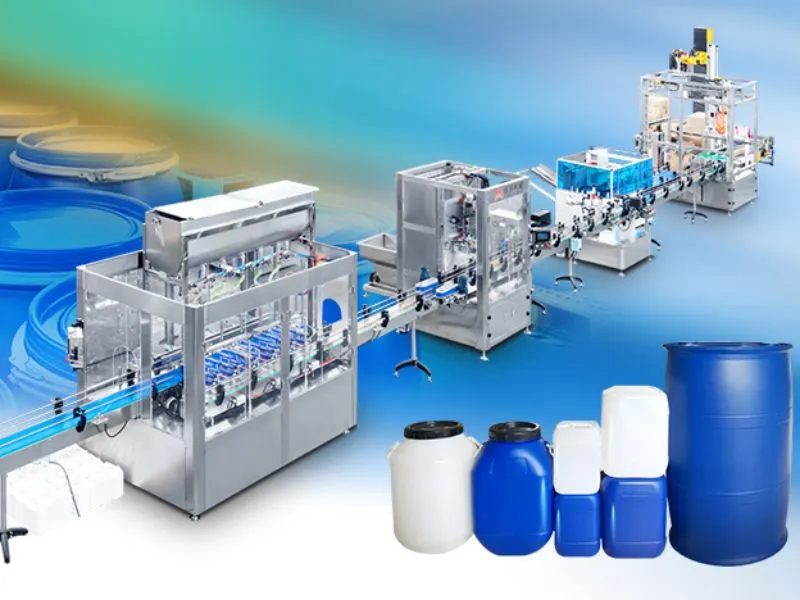
Popular types of small production lines
With its flexibility, cost savings and suitability for many fields, small production lines not only help optimize the production process but also meet market demand well. Some popular small production lines today.
- Food production lines
The food industry is one of the most widely used fields for small production lines. These lines are often designed to produce small or medium-sized foods.
For example:
- Confectionery production: Automatic or semi-automatic candy production lines, from mixing ingredients, shaping to packaging products.
- Bottled water: The line includes water filtration, bottling and capping stages. This is the optimal choice for businesses selling purified drinking water.
- Pre-processed foods: Compact lines are used to produce instant noodles, sausages, or convenience foods.
Food production lines help businesses quickly bring products to market without having to invest heavily in complex machinery.
- Plastic and packaging production lines
The plastic and packaging industry is also a prominent field when using small production lines. These systems are designed to produce plastic and packaging products at low cost and high efficiency.
Common applications:
- Plastic bags: Plastic bag production lines are suitable for small shops or packaging enterprises.
- Plastic boxes: From disposable plastic boxes to food containers, this production line can meet diverse production needs.
These lines not only meet market demand but also help businesses improve productivity in limited space.
- Household appliances production lines
Household appliances are one of the popular fields using small production lines, thanks to the diversity of products and not too complicated production requirements.
For example:
- LED lights: LED light production lines with automatic assembly capabilities, ensuring light quality and product durability.
- Small fans: Small fan production lines are designed to create simple but highly applicable products.
- Basic household appliances: Such as mini rice cookers, hand blenders or small vacuum cleaners.
- Mini construction material production lines
In the construction sector, small production lines are gradually replacing manual production methods thanks to their efficiency and cost savings.
Typical applications:
- Production of unburnt bricks: Mini unburnt brick production lines, suitable for small projects or local businesses.
- Block bricks: Production of all kinds of block bricks used in construction, meeting quality standards and minimizing environmental impact.
Mini construction material production lines bring great benefits to small and medium-sized enterprises when they want to invest in the construction industry without needing too much capital.
Conclusion
Small production lines are becoming an inevitable trend thanks to their flexibility and economic efficiency. Depending on the field of operation, enterprises can choose the appropriate type of line to optimize the production process, improve productivity and meet market demand.
With the development of technology, small production lines are not only a support tool but also a foundation for enterprises to affirm their position in the market.
