


What is Additive Manufacturing?
17-08-2025 394
Additive manufacturing (AM), also known as 3D printing, is a manufacturing process that builds objects layer by layer using digital 3D models as blueprints. Instead of subtractive manufacturing, additive manufacturing adds material to build the final product.
Mục lục
Additive manufacturing (AM), also known as 3D printing, is a manufacturing process that builds objects layer by layer using digital 3D models as blueprints. Instead of subtractive manufacturing, additive manufacturing adds material to build the final product.
Understanding what additive manufacturing is is important for manufacturing business owners. It is a computer-controlled 3D printing method that deposits material, often layer by layer, to create three-dimensional objects. This method is also known as layered additive manufacturing (ALM).
Understanding what additive manufacturing is is important for manufacturing business owners. It is a computer-controlled 3D printing method that deposits material, often layer by layer, to create three-dimensional objects. This method is also known as layered additive manufacturing (ALM).
How does additive manufacturing work?
Additive manufacturing (AM) leverages computer technology to create plastic models directly from a computer and has become popular because of this ability. Since then, the phrase ‘3D printing’ has become popular, although the method has changed fundamentally, especially in relation to the use of raw metal materials.
Components are produced layer by layer using AM. Several methods can be used, depending on the application. Each time, metal powder and a digital three-dimensional design that the ‘printer’ can understand and use serve as the foundation.
Types of Additive Manufacturing
Here are the types of additive manufacturing used:
1. Binder Jetting
One of the most common forms of additive manufacturing is binder jetting, also known as material jetting or powder jetting.
This technology creates three-dimensional products, which is the only thing that makes it different from your average office printer. Instead of spraying ink onto a sheet of paper, binder jetting pushes glue into a powdery substance. The print head rotates vertically and horizontally with each print, adding a new layer of build material.
2. Directed Energy Deposition (DED)
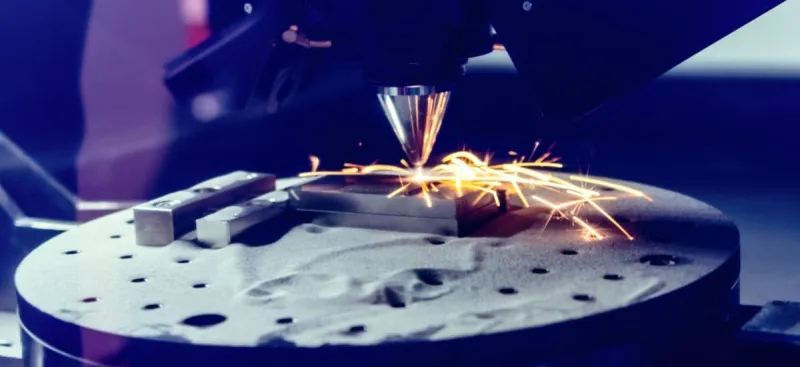
Three-dimensional objects are created using the principle of Directed Energy Deposition (DED) welding. A focused energy source, such as a laser or electron beam, melts a substance, usually a metal wire or powder. After the liquid material is precisely poured onto the build platform, it quickly solidifies and forms a layer. This process is repeated until the printed object is finished.
3. Material Extrusion
Material extrusion serves a similar purpose to a hot glue gun. As the roll of material is fed into the printer, it is heated until it melts at the nozzle tip.
Material extrusion has limitations while being the most affordable additive manufacturing technique. You can only use plastic polymers because the heating elements are not powerful enough to melt dense materials like metals, making them unsuitable for applications like machining and assembly.
4. Powder bed fusion (PBF)
The electron beam melting (EBM) process starts with a large bed of pulverized material, often consisting of sand, metal, plastic, or ceramic powder.
PBF produces highly complex items, making them more durable than items made using some other additive manufacturing methods. Keeping the work area clean can be difficult with this method because of the need for a powder bed.
5. Lamination
A form of additive manufacturing called lamination, also known as ultrasonic additive manufacturing (UAM) or layered object manufacturing (LOM), involves stacking thin sheets of material and joining them together using ultrasonic welding, bonding, or brazing.
6. Material jetting
Material jetting creates objects by layering material, much like adhesive jetting. On the other hand, material jetting melts wax-like materials and deposits precise droplets onto a build platform instead of forming adhesives on a powder bed. As the layers are added, the objects retain the shape of the layers themselves.

Additive Manufacturing process
Although these additive manufacturing techniques use 3D parts with different additive manufacturing processes, they all essentially follow the same additive manufacturing principles to create the finished product.
- Steps to Create a 3D Model
The designer initially creates a 3D model of the object to be printed using computer-aided design (CAD) software or a 3D object scanner. Since the part is a replica of the 3D model, it must be accurate in every detail and have a fully defined external geometry.
Although additive manufacturing (AM) can print complex parts, the product designer must follow certain guidelines and restrictions to achieve the best results. Design manuals vary depending on the type of additive manufacturing technique and material selection. Machine manufacturers and companies that provide additive manufacturing services have substantial design manuals.
- Steps to Create an STL File
Once the designer is satisfied, the user changes the CAD file into a standard lithography language (STL). STL is an AM format that 3D Systems created in the late 1980s for use in their Stereolithography (SLA) machines.
Any model can be saved as an STL file in most CAD programs, including SolidWorks, Inventor, and Catia. However, all printer manufacturers provide software that can convert any CAD format into an STL file.
- STL file transfer
The STL file is then sent to the printer, usually with the help of dedicated printer software, where the model is adjusted to suit the printing purpose.
- Equipment setup
Setting up a new print job involves different steps and prerequisites for each additive manufacturing technology and its variants. Setup includes material selection, printer orientation, temperature control, support structures, and leveling the build platform. It also requires the loading of consumables such as adhesives and printing media into the machine. The machine's software then converts the STL file data into G-code. G-code commands tell actuators, such as motors, where to go, how fast to go, and in which direction to go.
- Building the Part
Once the build process begins, the design is built up layer by layer. The intermediate layer is about 0.1 mm thick, although it can be as thin as 20 microns, depending on the technology and material.
- Post-Processing
Almost all additive manufacturing processes require post-processing in some capacity. Depending on the AM technology used and the intended function of the part, this can range from simple cleaning and polishing to part machining and heat treatment. Finally, post-processing may be required, such as cleaning, polishing, and painting.
Additive Manufacturing technology
Some people still associate AM with prototyping. However, this is no longer the case. Several standard processes currently have tools that can be manufactured via 3D printing. Furthermore, manufacturers would benefit from learning about examples of additive manufacturing before embarking on large-scale production. AM technologies can be broadly classified into three categories.
The first is sintering, which involves heating a material without liquefying it to create complex, high-resolution shapes. While selective laser sintering uses a laser to fuse thermoplastic powder particles together, direct metal laser sintering uses metal powder.
The second AM technology involves completely melting the material, and includes electron beam melting and direct metal laser sintering, both of which use a laser to melt layers of metal powder.

Advantages of Additive Manufacturing
Here is a list of the benefits of additive manufacturing:
- AM can print complex 3D geometries with internal features without the use of any tools.
- Less waste than machining
- A part can be manufactured directly from a 3D model without the need for a sketch.
- Rapid prototyping allows designers to test different variations, speeding up the design cycle.
- For smaller batches, less or no tooling is required than with conventional machining.
- Production tools can be printed.
- During the printing process, different materials can be combined to create special alloys.
- The same alloy can be used in different ways in different parts.
Disadvantages of Additive Manufacturing
Here is a list of disadvantages of additive manufacturing
- The build process is slow and expensive as the technology is still developing.
- High equipment costs are the reason for the high production costs.
- Different post-processing tasks are required depending on the type of additive manufacturing used.
- The build volume is small compared to other manufacturing part sizes, such as sand casting.
- Because of poor mechanical properties, post-processing is required.
- Surface smoothness and texture can be better than manufacturing techniques such as computer numerical control (CNC) and investment casting.
- Compared to manufacturing techniques such as CNC machining, investment casting, and die casting, the product strength is significantly lower.
.jpg "Sản xuất bồi đắp")
Problems with Additive Manufacturing
The challenges of additive manufacturing are also numerous. Additive manufacturing equipment can cost hundreds of thousands of dollars, and it takes longer to use it to produce large batches than it does for conventional manufacturing.
Additionally, many additively manufactured items require post-processing, such as cleaning and smoothing sharp edges. Experts say ensuring your final product is of good quality is one of the most difficult problems. It presents additive manufacturing with some of the most incredible materials science challenges. How can you reduce the number of potential defects?
Metals aren’t the only materials that can have defects when created using additive methods. Since additive manufacturing is still relatively new, researchers are trying to understand its various components, how materials interact, and how best to reduce the likelihood of defects in finished products.
What materials can be used in additive manufacturing?
With processes such as machining, the amount of material is known. A part initially exists as a block of material, forged or cast. Despite the machining process, its inherent material properties remain unchanged.
In additive manufacturing, however, the geometry of the part is established simultaneously with the material properties. This creates additional opportunities as well as challenges specific to additive manufacturing. It is possible to purposefully and precisely tailor the material properties of specific parts by introducing properties such as porosity, hardness or flexibility when the material properties are defined along with the geometry.
Polymers, ceramics and metals are three materials that can be used in additive manufacturing. Although polymers are more commonly used than other materials, all AM processes allow for the use of these materials, although some additive techniques encourage the use of specific materials over others. Materials are typically produced in the form of filament or powder feedstock.
Additional materials include polymer sheets or adhesives for LOM, paper, adhesives, and chocolate. Materials such as composites and sand can also be used in AM. The final quality depends largely on the material. Any material can be printed layer by layer, and high temperatures and pressures can change the microstructure of the material.
Potential of Additive Manufacturing
The production of improved bulk materials with desired composition, microstructure, and properties has a bright future with AM techniques. However, the unpredictable and uncontrollable nature of the production of phases and microstructures in AM methods remains a significant obstacle due to the widely non-equilibrium nature of laser processing and the complex interactions between material and process parameters.
